Showing posts with label Olympics. Show all posts

I can do anything better than I can


Maybe you've heard the song "Anything You Can Do" from the musical "Annie Get Your Gun." It's a classic duet with the characters Annie Oakley and Frank Butler attempting to prove their ability to outdo each other in a variety of tasks. 

Some people are more competitive than others; I'm not a fan of my competitive side (I take competition a little too seriously, so I choose not to compete with others), but I do enjoy competing with myself!

As a speaker, it can be really easy to fall into the trap of comparing ourselves to and mentally competing with others. While it's often helpful and motivating to find inspiration in the veterans who have achieved the goals we're still striving for, it can also be demotivating to perceive our own levels of success to be disappointing in comparison.

I wrote this in another post, and will share it here as a reminder:

"Where were you a month ago or a year ago in your development? Look how far you’ve come! Look at what you’ve accomplished over time. When you compare yourself to yourself, you’re much more likely to come out ahead. And if not, at least you know intimately where you’re letting yourself down in your own growth and improvement....

When you understand the value and unique perspective you bring to your audiences and clients, there is no longer any need or desire to be like or to copy someone else."

Instead of "Anything you can do, I can do better," how about trying this reframe, from Visa's Olympic-inspired commercial? Athletes compete against others, but also fully embrace the challenges of competing against their own best performances.

(Lyrics below the video.)


If you'd like some help with the mindset part of your speaking toolkit, in addition to pumping up your speaking skills and strategies, you can still sign up for my Shake Up Your Speaking retreat, coming up March 19-21. Don't wait too long, though; there are only four spots left!

Lyrics:

Anything I can do, I can do better
I can do anything better than me
Yes I can. Yes I can. Yes I can. Yes I can.

Anything we can be, we can be greater
We can be anything greater than we
Yes we can. Yes we can. Yes we can.

I can do more than I ever imagined
I can do more than I ever dreamed
Yes I can. Yes I can. Yes I can.
Sooner, not later I'm greater than me

____________________________________________________
On The Everything Page you'll find everything you need to build visibility, credibility and influence through engaging presentations that move your participants into action: freebies, low-cost products and courses, and 1:1 coaching!

Lessons from the Olympics: Turning a mistake into a win


If you watched the opening ceremony of the Winter Olympics, you noticed that there was a snafu with the display of the Olympic rings, when an electronic snowflake that was supposed to expand into the fifth ring never opened.

I've written in the past about elite and Olympic athletes who don't dwell on mistakes, but get up from a fall or crash and keep performing, sometimes going on to achieve even more than expected. Well, clearly, Olympic ceremony designer Konstantin Ernst has the same die-hard spirit.

In the closing ceremony, the rings were formed by a group of dancers wearing glittering costumes. As the rings formed, one group of performers instead stayed in a small, tight circle (to represent the opening night snowflake) for a few hilarious moments, parodying the opening night mishap. But unlike the opening ceremony, the fifth ring finally expanded and joined the rest.

Watch here: https://youtube.com/shorts/Py_hcezSLAA?si=97HWtyRX96F3pffU

By incorporating his mistake and poking fun at what initially was probably somewhat embarrassing, Ernst shows his sense of humor, his flexibility, his willingness to laugh at himself, and his ability to take a mistake and make something even better out of it.

We're all going to make mistakes on stage. For most of us, millions of people around the world won't be watching. But for our audiences who are, demonstrating grace and resilience under pressure, a sense of humor, and the understanding that we're all human will go far to entertain and connect with the audience -- and perhaps give our presentation that extra luster that people will remember long after it's over.


____________________________________________________
On The Everything Page you'll find everything you need to build visibility, credibility and influence through engaging presentations that move your participants into action: freebies, low-cost products and courses, and 1:1 coaching!

In speaking, as in sports, the reward outweighs the risk


Photo: World Figure Skating
The Winter Olympics are full of risk-taking athletes. They jump, they spin, they twirl, they flip, they slide, they glide, and they push as hard as they can -- all at the risk of falling on their behinds and losing time, points and medals.

For a lot of the athletes, they know they might fall down, and even face serious injury, but that doesn't keep them from performing at the highest level.

For example, the announcers talked all week about  two-time World Champion figure skater Mao Asada, one of a handful of skaters who has landed a triple Axel in competition. Would she be able to accomplish this high-scoring feat during her short program?

Asada attempted but did not land her Axel in the ladies's short program. She was a favorite for the gold medal and the reigning silver medalist. She took the risk and didn't succeed, in fact, falling down to 16th place.

But the potential reward was worth it for her. She still performed her long program like a champion and -- guess what -- she landed the triple Axel and a plethora of other triples and combinations. Unfortunately, she was out of the running for a medal, finishing in sixth place. In the end, her score was a personal record.

Was she disappointed not to win a medal? Of course. Do you think she regrets taking the risk? Not for a minute. She said to a reporter, "With this performance, I could thank all the people who supported me all this time."

There are snowboarders and skiers who try extremely risky tricks, some of which they've only completed in practice and never in competition. But the potential reward outweighs the risk, which is why they do it. The chance of representing your country with a gold medal is a huge motivation, not to mention delivering personal best performances and justifying years of hard work.

How does the reward of speaking outweigh the risk for you? 

We all experience some risk when we get in front of an audience. We know there's a chance we might come across as less than stellar, that the performance we imagine in our heads might be a whole different thing in reality. We know we might forget our words, have a technology breakdown, or demonstrate our nervousness with shaking hands or quivering voice.

But are these risks really so huge when you think about the rewards?

As I mentioned in this post, some of the rewards of speaking include:
  • The opportunity to share your message with a captive audience
  • Learning about yourself as a person, and facing your personal challenges
  • Connecting with people and building relationships
  • Helping people move forward and take action
  • Expressing your ideas, changing minds and facilitating personal transformation
  • Not to mention building your visibility, credibility and reputation, which leads to promotions, clients, customers, more important leadership roles, and personal and professional growth.
You're not in danger when you speak. You're not going to get a concussion or tear your ACL. You're not going to be fired or shunned from society. The rewards far outweigh the risks. So what are you waiting for?

____________________________________________________
On The Everything Page you'll find everything you need to build visibility, credibility and influence through engaging presentations that move your participants into action: freebies, low-cost products and courses, and 1:1 coaching!

Connecting without words: Lessons from Jason Brown's performance


It's that time again, when the ramp-up to the Olympics is ... rampant. There are national championships galore, in just about every winter sport, and you can start getting your Olympics fix right now, weeks before the games begin.

I'm a figure skating fan, but I missed the U.S. Nationals, which is why I was intrigued when I started seeing Jason Brown's name all over social media. He's a young skater, just a year out of the junior ranks, but he must have done something pretty amazing to warrant so much attention. So I watched.

The announcer gives a little hint right up front at what makes Jason Brown so notable: his ability to connect with the audience. When you watch this performance, I think you'll agree that he's a master of connection. And yes, all while skating, doing impossible jumps, footwork and spins -- and while not speaking a word.


If you can't see the player, click this link to watch on YouTube.

Watch how he times his jumps and gestures for when he's directly in front of the audience. Watch how he makes direct eye contact, even as he's whizzing by them at high speed. Watch the smiles and facial expressions that demonstrate his enjoyment and the fun he's having on the ice. Watch the audience rise to their feet in a standing ovation before the routine is even over. They just couldn't control themselves!

There are figure skaters who clearly take themselves too seriously. They never smile. They never connect with the audience. They seem to be in their own little world, focusing on not making mistakes and on technical elements. And there are speakers who do the same thing.

In this sport, however, competitors are judged not just on their technical proficiency, but also on performance, interpretation and other artistic elements. As are speakers when they stand up in front of an audience. Performance is necessary. Entertainment value is critical. To those of you who think speakers must be serious and somber and pompous and grim in order to be taken seriously, you are missing a huge emotional component. Your score will suffer.

Which is why young Jason Brown, with only a year of senior competition under his belt, came in second to veteran skater Jeremy Abbott and was chosen as only one of two American men to skate at the Sochi Winter Olympics.

How are you finding ways to connect with your audiences... without words?

____________________________________________________
On The Everything Page you'll find everything you need to build visibility, credibility and influence through engaging presentations that move your participants into action: freebies, low-cost products and courses, and 1:1 coaching!

Drop the low and high scores to read your audience better


If you've ever watched the Olympics, you've probably seen figure skating, diving or gymnastics, three sports that are scored by judges, as opposed to sports that are scored by time, speed or distance achieved.

Because scoring can be subjective, these sports all have a built-in protection against bias: The low and high scores in each event are discarded, leaving the remaining scores to be averaged, combined or otherwise calculated in some (usually highly technical) way.

If you ask your audience to fill out evaluations or give any kind of feedback after your presentations, you will also discover bias among your "judges."

Some audience members will love you to pieces no matter what you say or do. Some will just not click with you, no matter what you say or do. The rest will be along a continuum somewhere in the middle.

As I wrote in this blog post, paraphrasing Scott Ginsberg, it's far too easy to dwell on the 10% who have negative things to say, rather than the 90% who are more positive. But the truth is, there will always be that top and bottom 10%, who are both probably equally unreliable indicators of the overall quality of your presentation.

When analyzing your evaluations, or even if you're just analyzing your audience's reactions in the moment, remember to discard the highest and the lowest "scores," and you'll have a more accurate reading of how your audience is truly responding to your presentation.

____________________________________________________
On The Everything Page you'll find everything you need to build visibility, credibility and influence through engaging presentations that move your participants into action: freebies, low-cost products and courses, and 1:1 coaching!

What if you could share your message only once every four years?


Do you take your speaking opportunities for granted?

Do you rehash the same presentation over and over without refreshing the stories or finding new and better ways to express your concepts? Do you give the same canned talk to every group without bothering to find out who's in the audience? Do you feel burdened and put-upon every time you speak instead of feeling gratitude for the opportunity to educate, inform, persuade or entertain this group of people who have give their time to hear you?

Now consider this: What if you could share your message only once every four years? But when you spoke, you had a worldwide stage?

How would you present differently?

* Would you make an extra effort to be clear and concise, so there was no confusion about what you were saying?

* Would you test your equipment first to make sure you knew how to use your presentation remote and your microphone?

* Would you go to great lengths to provide relevant and valuable content to your audience, because you might not get another chance to be in front of them?

* Would you commit to thorough preparation and practice so you could be almost 100% sure of knowing your stuff, delivering it well and not wasting the audience's time?

* Would you pay more attention to your visuals, your props, and your methods of involving and interacting with the audience in order to keep them engaged the entire time?

Once every four years, we're able to watch the world's elite athletes compete at the highest level of their ability. They train year-round to peak at exactly the right time for their most prestigious competition.

The difference between Olympic athletes and (many) speakers, however, is that elite athletes push themselves to do better ALL the time. Not just when the Olympics roll around. Whether they have a worldwide audience or they're competing at a non-televised event like the Mt. Sac Relays, they always bring their A game.

They might hold back a little in the preliminary rounds to save energy for the finals, but they are still competing at a level far above the average athlete, and their process is well thought out and carefully planned.

Speakers, however, frequently do the bare minimum to get through an engagement. They put their presentations together at the last minute; they pay no attention to who's in the audience, and they focus only on their own comfort and convenience by reading from bullet-laden slides and drowning the audience in data.

Only when an "important" presentation comes their way (based on the size of the audience or the impressiveness of the people attending) do they suddenly awake from their comatose state and leap into action.

Unfortunately, because there is no regular habit of proper preparation or commitment to excellence, this speaker is at a loss. He can't even begin to figure out how to create or deliver an effective presentation because he has built up no "muscle memory" over time of the speaker habits that are necessary to make this happen.

Every time you speak is an opportunity to improve, to strengthen your skills, to build your speaking and confidence muscles. Every time you speak is an opportunity to put your best out there. Every time you speak is an opportunity to make an impact, give value and be memorable.

It's all up to you.

If you feel that your presentations aren't where you want them to be because you don't know where to begin with your own process for creating audience engagement, I'll be offering my new teleseminar series, "Speak to Engage: 7-Step Shortcut to Public Speaking Success," this fall. Get on my advance notice list (which will still be open for a short time) to get updates, early bird specials and other goodies as we get closer to launching the program.

____________________________________________________
On The Everything Page you'll find everything you need to build visibility, credibility and influence through engaging presentations that move your participants into action: freebies, low-cost products and courses, and 1:1 coaching!

Feeling the pressure or feeling the excitement?


"You ask her about feeling the pressure and she says 'I don't really feel it." And you know, I think it's because she labels it something different in her head. Some kids feel anxiety, feel pressure. She feels excitement. It's just how you label that."

~ Tim Daggett, Olympic gymnastics commentator, referring to gymnast Aly Raisman

How do you label your public speaking nervousness? Do you say, "I hate public speaking?" Do you tell yourself you shouldn't be anxious and then feel disappointed when you can't make the jitters go away?

How about taking that adrenaline rush and turning it around?

How about saying to yourself, "I'm excited to have the opportunity to share my message with this audience?"

How about finding ways to relax your body and ground yourself so that your jitters become more manageable?

And then, how about using that remaining adrenaline to give the audience the best, most energetic and passionate, version of YOU?

____________________________________________________
On The Everything Page you'll find everything you need to build visibility, credibility and influence through engaging presentations that move your participants into action: freebies, low-cost products and courses, and 1:1 coaching!

How can Olympic athletes help you become a better speaker?


As you know, I find athletes' mental and physical preparation practices to be a great model for speakers. So here's an article from the BPS Research Digest blog about Olympic athletes' mental strategies, and there's some great learning here for speakers. (The abstract is here, with additional notes.)

Athletes have some of the same insecurities as speakers; for example, one athlete in the study says, "In some circumstances my intention is not to do the best but to avoid making a bad shot. That is when I make a bad shot. When I think about avoiding the error, I make the error."

How many times have we talked about this kind of self-fulfilling prophecy, called "ironic effects" in the article.

On the positive side, "several of the athletes said that during the days before an event they attempted to recreate the emotional stress of a real competition. They also said they prioritised relaxation time, set themselves goals and mentally rehearsed success."

Sound familiar?

"The athletes also reported devoting considerable time to post-contest evaluation, especially so as to learn from their mistakes."

Go check out this article at BPS, and look at these blog posts to see how athletes' mental and physical preparation can help you improve as a speaker:

Cool as a cucumber or sweaty like a racehorse

Pressure to perform

Psych yourself up... or out

Concentrating or worrying?


Experience vs. practice


Visualization is for the body as well as the mind

Are you playing like a champion?


Lessons from the Olympic Trials (four parts)

Pressure

A philosophical approach to failure

I do and I understand, Part 1 and Part 2

Public speaking touchdown


____________________________________________________
On The Everything Page you'll find everything you need to build visibility, credibility and influence through engaging presentations that move your participants into action: freebies, low-cost products and courses, and 1:1 coaching!

A philosophical approach to failure


How's your attitude?

It's not just in the content, delivery, props and equipment that a speaker delivers a complete package. It's in the mental readiness, calmness mixed with excitement, a flexibility to go where the audience needs and wants to go, and a willingness and ability to handle whatever comes along.

Athletes, of course, are experts at mental preparation, as I've talked about here and here.

But what happens when things don't go as planned? This is when mental preparation and a healthy perspective can have the greatest benefit.

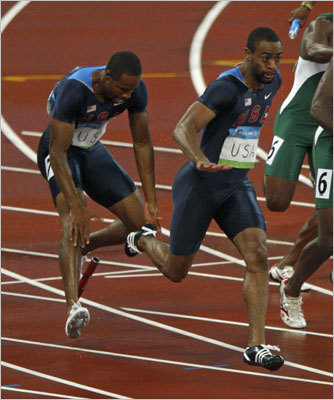
"It's kind of difficult to go home with no hardware, but you know, I'm gonna suck it up and cheer on the rest of my teammates."

~ Tyson Gay, after the U.S. 4x100 relay team failed to pass the baton on the last leg of their first heat

If Tyson Gay had just had one bad day, I could see how he might have this kind of attitude. But Gay, defending world champion in the 100 and 200 meters has suffered one defeat after another. First, he pulled a hamstring during the trials and lost his chance to compete in the 200 meters at the Olympics. Then he failed to make the final in the 100 meters and ended up watching his main competitor break a world record.

Not only will Gay leave the Olympics without a single medal, he didn't make it to a single final in his events.

I don't know about you, but I'd be pretty angry. I might even blame other people. And I probably wouldn't want to talk to a reporter after yet another embarrassing defeat.

But athletes aren't just prepared for winning. They're also prepared to lose. That's not to say they think about losing or visualize losing or make losing an option.

But they know they've done everything they can do to win. They've prepared completely, both mentally and physically. They've practiced as much as they can. In that moment, they've done all they can do.

And when things don't go as planned, they can be philosophical about it. Like Tyson Gay and other athletes I've heard interviewed over the past two weeks at the Olympics.

And not only can they be philosophical about the present situation, but they can also look ahead and see themselves succeeding again in the future.

How's your attitude? Have you done all you can do in your physical and mental preparation?

(Reuters Photo)

____________________________________________________
On The Everything Page you'll find everything you need to build visibility, credibility and influence through engaging presentations that move your participants into action: freebies, low-cost products and courses, and 1:1 coaching!

Feel the fear and speak anyway


My audiences and clients are frequently surprised when I tell them I still get nervous before a presentation. I'm not afraid of public speaking, but like most speakers, I do feel pressure to perform, to give my best and to avoid making egregious and embarrassing mistakes.

It's perfectly natural to feel nervous and excited at the same time, and to still go forward, not being entirely sure of what will happen or feeling completely in control of the situation.

If you're truly afraid of public speaking, though, it might be hard to believe that you can get to this place.

Here's a quote from someone who lives the motto, "Feel the fear and do it anyway" every day:

"Actually, I'm afraid of heights... . I still haven't lost the fear. Like if you asked me just to jump straight off, without doing the dive and all, I wouldn't do it. So I have to have something to distract me on the way down."

~ Haley Ishimatsu, 15-year-old Olympic platform diver

If Haley Ishimatsu, who's afraid of heights, can jump off a 30-foot platform every day to challenge herself, perhaps there's hope for you!

The question is this: What do you have to do and what are you willing to do to get yourself to that place?

____________________________________________________
On The Everything Page you'll find everything you need to build visibility, credibility and influence through engaging presentations that move your participants into action: freebies, low-cost products and courses, and 1:1 coaching!

Related Posts Plugin for WordPress, Blogger...