Showing posts with label General Comments. Show all posts

Sometimes you're not meant to be part of the conversation


I was once reading a conversation started by a Black person about anti-Black hate crimes, and I thought it would be helpful to mention antisemitism and the hate crimes that Jews experience.

Why did I think that would be helpful? 🀷🏻

Maybe I thought Black people needed to know that Jews are also victims of violence? (Nope, they already know that.)

Maybe I thought I was offering solidarity? (I wasn't. I was making it about myself.)

Maybe I thought the conversation needed "different perspectives?" (It didn't. It was a conversation meant to educate and bring awareness about people's lived experiences, not to ask for different opinions.)

This was a huge learning experience for me, realizing that sometimes it's not actually about ME. Sometimes my opinion or perspective is not needed or relevant. 🀯

As a communication junkie and natural-born opinionated bigmouth, I have spent my life inserting myself into conversations that were not meant for me. I tend to think my opinion is incredibly valuable and worthwhile and that everyone should hear it. πŸ“’

Now, if I want to create awareness of antisemitism, I can make my own post. I can share my own resources. I don't need to hijack someone else's post about their lived experience and try to insert my own, when it's not relevant.

I'm unlearning some things. Just because people are talking publicly about something on social media doesn't mean they want to hear "my side of the story."

Sometimes a topic is open for discussion and different perspectives.

Sometimes there's only ONE SIDE and we need to just shut up and listen. πŸ‘‚πŸΌ

To clarify:

Men: learn from the experiences of women.

White women: learn from the experiences of Black women and WOC.

White people: learn from the experiences of Black people and POC.

Straight people: learn from the experiences of LGBTQ+ people.

Cisgender people: learn from the experiences of trans and nonbinary people.

Non-disabled people: learn from the experiences of people with disabilities.

Etc.

Most of us have multiple identities, so listen to the ones you are not a part of!


____________________________________________________
On The Everything Page you'll find everything you need to build visibility, credibility and influence through engaging presentations that move your participants into action: freebies, low-cost products and courses, and 1:1 coaching!

What if you lost your words?


Remember how boring "vocab" was when we were in school? Learning the meanings of endless words that we probably would never use? 

I don't think of vocabulary very often, but since my dad had a stroke on Tuesday, it's been top of mind. He briefly lost his ability to communicate, and even hours later, was still transposing words and unable to capture the words he wanted to say.

My dad is a COMMUNICATOR, in all caps! He's always loved words and language, and when I was growing up, "Get out the dictionary" was our most-repeated command! I get my love of language and words from my dad, most definitely. πŸ“š

He reminded me the other day, from his hospital bed, of the enormous vocabulary I had as a child. He said, "Remember when they tested your vocabulary in elementary school? Remember how many words you knew?" I don't remember the number, but apparently it was impressive.

He reflected on how it's better to start out with a huge vocabulary, then if you have a stroke and lose some of your words, you'll still have plenty to work with! Haha - My dad and I are both optimists. We're all about the silver lining. 🀷🏻‍♀️πŸŒ₯

How is vocabulary relevant for you as a speaker and communicator?

First of all, don't go out and start using a bunch of big fancy words in your presentations. 

🚫Never use language to distance yourself from your audience.🚫

But consider how you use vocabulary to express yourself in a way that's aligned with your personality, your speaking style and your intellectual property. 

Are you still learning new ways of expressing yourself? Are you still building your vocabulary?

My favorite vocab-builder is the old-timey thesaurus (and I still love the dictionary), but I don't use it to find words or expressions that are not authentic to me. I use the thesaurus to find words that fit my communication style, but ones I haven't remembered or that express my idea better than the original word on my mind.

Of course, reading is always a great way of improving vocabulary, as well as actually using new words in context in conversation.

I know that the older I get, the more I lose vocabulary. I forget words I once knew because I'm not using them regularly or I haven't come across them in my reading.

I'd love to know if you are a πŸ€“word nerdπŸ€“ or a πŸ’language lover!πŸ’ Comment below. πŸ‘‡πŸΌπŸ‘‡πŸΌπŸ‘‡πŸΌ

And my dad is doing great. He had a second stroke in the hospital, but sounds like his old self and will hopefully be going home tomorrow. We're having long conversations at his bedside, which I hope are helping his brain retain his words!


____________________________________________________
On The Everything Page you'll find everything you need to build visibility, credibility and influence through engaging presentations that move your participants into action: freebies, low-cost products and courses, and 1:1 coaching!

Do you cringe when you hear "white privilege?"


Equating racism with hate is a red herring for white people. (Or maybe just liberal "enlightened" white people.)

Making hatred the defining characteristic of a racist person allows white people to disengage from the exploration of white privilege and implicit bias.

I’m going to go out on a limb and wager that the majority of the people I know and love don’t actually hate anyone based solely on their race, ethnicity, religion, weight, sexual orientation, physical abilities, or socioeconomic status. 

(Maybe some of you do hate people based on these attributes. Then I guess this post isn't for you. And we shouldn't be friends.)

It’s easy to think that, because you don’t “hate” anyone or you’re not “mean” to anyone, you can’t possibly be contributing to racism.

You may not hate anyone, but if you’re white, you still benefit from a system of institutionalized racism that discriminates against people of color. 

You may not hate anyone, but you are part of a society that, from textbooks to news media to movies tells – at best – an incomplete and stereotyped story of the lives and contributions of POC and – at worst – a completely false and dangerous story.

Study up on white privilege, read about implicit bias, acknowledge your defensiveness when you hear the words "hate" and "privilege," listen to the experiences of POC, and find ways to take tangible action to break down the systems and policies that put nonwhites at a lifelong disadvantage.

If you want to put the focus on love and kindness, please also remember to focus on personal responsibility for self-awareness and action.

And if you don't feel that the words "hate" or "privilege" apply to you, keep listening, reading, and studying anyway. Don't let the words distract you from the work.


____________________________________________________
On The Everything Page you'll find everything you need to build visibility, credibility and influence through engaging presentations that move your participants into action: freebies, low-cost products and courses, and 1:1 coaching!

I have a secret...


There are so many great online programs out there, and I have several coaches whose programs I'm pretty much always going to join.

But most programs have a Facebook group component, and this is where I find myself holding back from signing up for a program, especially if I know that this program has 50 or 100 people in it. 

When I'm about to join a group with 50+ people all doing the same homework every day, I get super anxious.

Am I supposed to comment on and like all 50+ people's posts every single day in a 31-day challenge or an 8-week program? How am I going to have time to watch all 50+ introduction videos and other videos? How am I going to support others while also getting my own work done? 

I'm highly apprehensive about groups. In fact, I really don't like 90% of the groups I'm in.

I don't like being in groups that don't have active participants, obviously, and I feel sad and lonely if no one likes my posts, so I want to be active for the other people in the group. 

But I also don't have all day to spend in a group making sure other people get likes and comments. I have anxiety and guilt pretty much every time I'm in a program or challenge group.

This past weekend, I started leaving Facebook groups. I'm still in a LOT. Too many, in fact. 

The ones I'm paying for, I keep, and I do my best to balance my own needs with being supportive of others.

Ones I'm not paying for, especially ones I've never been active in, that seemed like a good idea at the time, those are gone.

Groups that are community-based, like local buy/sell/trade groups, I keep for their usefulness when and if I need them.

And then there's that "other" category: groups I joined to help or support a friend or colleague, but that I never really pay attention to. Arrrgh. What do I do about THESE groups?

I'd love to hear your thoughts on (large) groups. I'm in some smaller groups that are perfectly manageable. 

But when you're in a large group, do you feel compelled to support everyone else? 

Do you feel guilty if you comment on some posts and not others? 

Do you do "drive-by likes" where you just like every new post so people don't feel ignored?

Share your thoughts, guilt, anxiety, or love of groups!


____________________________________________________
On The Everything Page you'll find everything you need to build visibility, credibility and influence through engaging presentations that move your participants into action: freebies, low-cost products and courses, and 1:1 coaching!

Is busyness a competition?


People are busy. People are overwhelmed. People have too much on their plates. And yet, the complaint is often laced with pride.

We can't wait to tell everyone how busy we are. "How are you?" "SO busy!"

Perhaps busyness triggers our competitive nature. At least, I think it triggered mine.

Back in the late 90s, after having started and run my nonprofit organization for several years while also working a full-time job, I started noticing a tendency to brag about my busyness. The busier I appeared and the more meetings and events I organized and attended, the more important I felt.

Perhaps it made me feel needed and wanted in the world. If I was busy, it was because I was indispensable. Right?

But I got tired of the constant pressure. I was exhausted. Sure, being busy made me feel successful, but why did I require this particular definition of success? And why did I care so much if other people perceived me as busy?

So I made a conscious effort to stop this endless competition.

When I started to let things go and allowed myself to say no to being overwhelmed and taking on too much, I felt so much healthier and happier. I could tackle the things that were most important to me, and let the rest go.

The first time I read about busyness as a "badge of honor" in 2006, I was so relieved to discover I wasn't the only one who felt this way. The blog post was written by Adultitis-fighter Jason Kotecki, probably very close to the beginning of Kim and Jason's Escape Adulthood journey!

I now find it a relief not to be competing with everyone else for "who's the busiest." And I can really get down to the business of my business and my life. (Okay, I confess. Sometimes I compete at the other end of the spectrum: who sleeps the latest?)

I also sometimes still find it hard not to answer "Busy" when people ask "How are you?" Because isn't that what everyone says?

The latest busyness competition on social media is around how many Zoom meetings we're having in a day, thanks to COVID-19. (However, this pride in busyness pre-dates COVID-19 and will continue after it's gone.)

I've been doing my work virtually for over a decade. It's normal for me to have several virtual meetings in a day with clients and colleagues. But do I want to have eight meetings, just because I can, just because I don't have to drive somewhere? Nope.

We all know this is going on, and we're all exhausted by it. We do have a choice (at least my fellow entrepreneurs who are in charge of our own calendars). So why don't we stop?

____________________________________________________
On The Everything Page you'll find everything you need to build visibility, credibility and influence through engaging presentations that move your participants into action: freebies, low-cost products and courses, and 1:1 coaching!

How can I help?


You don't need any advice from me on hand-washing or social distancing. I'm not going to share "how The LisaB Company is responding to COVID-19." Pretty sure you don't care. πŸ˜‰ I'm not a mental health expert, a scientist or a life coach, and I know you can find resources on how to cope elsewhere.

What am I good at? How can I help? Especially from afar, from my living room, from my laptop? (Which, honestly, is my favorite place to be...)

πŸ—£ I can continue to support your speaking efforts, even (especially) if now your speaking engagements are virtual.πŸ—£

If you have time on your hands because your engagements have canceled; if you're working remotely and your commute is now from the bedroom to the kitchen table; or if you're home with the kids and need a "business break" while they're doing an assignment, I've got some options for you.

Prices reduced:

πŸ‘€ I've reduced prices πŸ’° or switched over to "choose your price" on my virtual programs temporarily, to make it easier for those in my community who want to use this time for some business and speaking growth.

These programs include:

Go Virtual: Take Your Training From Stage to Screen

Presentation Foundation Quickstart Kit

Create Your Own Exercises: Transform Your Audiences From Spectators to Participants

Speaking Success Checklist Bundle

Free:

I also want to remind you of my free offerings:

🌟My book, Presenting for Humans: Insights for Speakers on Ditching Perfection and Creating Connection (free temporarily)

🌟My blog, Speak Schmeak (over 1,500 posts on public speaking since 2006)

🌟Easy Speaker Proposal Template and tracking sheet

🌟Articles on LinkedIn

🌟Podcast and other interview audios

🌟Videos

I offer a wide range of free and low-cost tools for speakers to build skills and confidence, to learn how to engage and serve your audiences, and to make the greatest impact on those you serve, and I hope you find these helpful and practical!

Many entrepreneurs and business leaders are reassessing our business models right now, to make our businesses more robust and diversified, and I'm looking at my offerings as well to make sure I'm hitting the areas my community members need.

If there's something I'm not offering that would help you develop particular skills, please let me know!

And don't miss my next training on Thursday, May 7, "8 Steps to Ditching Perfection and Creating Connection." This affordable training is jam-packed with tips to help you get past the need for perfection and to set you up for success with your presentations.

Your audiences need you - now. Don't hold back! Kick perfection to the curb and release your genius!

Live speaking engagements will come back. This is a temporary setback. Make the most of your skills and experience NOW. And if you're so inclined, there is also work to be done to move forward.

Take care of yourself, my friends!

P.S. I have debated making some programs free. I'm just not in a position to do this, and as my business coach reminded me the other day, "Continuing to charge for our services is the only way we are going to stay afloat and save the economy. It's all a ripple." I honor every small business's struggle to keep going right now and I'm doing my best to support those I can. I hope you find my reduced-price options beneficial!

____________________________________________________
On The Everything Page you'll find everything you need to build visibility, credibility and influence through engaging presentations that move your participants into action: freebies, low-cost products and courses, and 1:1 coaching!

Empowering women means paying them


After yet another request from a women's organization asking me to speak for free, I wrote this post on Facebook. I then posted it on Instagram and Twitter, and as an article on LinkedIn. My speaking colleagues are sharing it and getting lots of comments! It's the closest thing I've ever had to a viral post. 😜

Feel free to share the LinkedIn article or this post, as this message needs to be shared widely! Yes, there are many more points that could have been added; this is just what came out in the heat of the moment!

A note to women's organizations: Does your mission include empowering women and teaching them to recognize and own their value? Do you offer professional development opportunities to help women grow in their careers or become successful entrepreneurs?

What message are you sending when you write checks for all the costs of your event: the venue, the food, and the A/V staff...

... but you ask your professional women speakers—the reason people even come to your event—to pay their own travel; cover all their costs of being away from home and office; take the time to prepare and practice a high-quality, engaging, entertaining, professional-level presentation customized to your group; and speak for FREE?

(Do you ask your doctor or plumber to work for free? Walk out of the grocery store without paying for your cereal? Expect to binge your Netflix shows without a subscription?)

Yes, you will likely find someone willing to speak "for exposure" (which doesn't pay our bills, and there is no guarantee of even one book sale, not to mention a high-paying client resulting from this "exposure"), so you may continue to believe this is an acceptable practice.

We love to "give back." But we usually already have favorite organizations that we've chosen for volunteering and philanthropy (you know who you are ❤️).

I want to ask you: Can you really say you believe in empowering women when you continue to devalue your women speakers? Are you willing to put your money where your message is?

#speakingupforchange

____________________________________________________
On The Everything Page you'll find everything you need to build visibility, credibility and influence through engaging presentations that move your participants into action: freebies, low-cost products and courses, and 1:1 coaching!

Why can't every talk be a TED talk?


TED talks are the "it girl" of speaking. Everyone wants their presentation to be as cool as a TED talk, as profound as a TED talk, and as viral as a TED talk.

I'm a huge fan of TED talks (and their locally-produced TEDx brethren). I've written about many of them here on Speak Schmeak, in fact. I admire the ability of TED speakers to quickly and concisely express their big idea in a compelling way, using stories, analogies and sometimes visuals to share their message.

When you only have 18 minutes or less to make an impact, you keep it simple.

However, in a TED talk, you also have minimal tools at your disposal. TED talks are time-limited on purpose: "...short enough to hold people's attention, including on the internet, and precise enough to be taken seriously. But it's also long enough to say something that matters."

In my workshops (which are often a day and a half long), I'm asked by my corporate training clients to address specific learning objectives and teach specific skills. Not only do I teach skills, but I also give my participants time to practice the skills they've learned.

I teach a range of public speaking concepts, provide activities and exercises to help the group internalize and remember the concepts, and then provide practical feedback as they practice the skills related to the concepts. There's also a lot of "white space," time to process what the group is learning, to take breaks and to sleep on new concepts.

Sorry, but 18 minutes isn't enough.

I remember reading a Seth Godin article once where he gave tips for effective presentations, and he suggested that the perfect length for a presentation was: "Most of the time, the right answer is, 'ten.' Ten minutes of breathtaking big ideas with big pictures and big type and few words and scary thoughts and startling insights. And then, and then, spend the rest of your time just talking to me. Interacting. Answering questions. Leading a discussion." Most of the time? I have to disagree.

There is no one right answer for how long a presentation should be. There is no one right answer for what style a presentation should be. There is no one right answer for "slides or no slides." 

There is no one right way to achieve the desired outcomes of a presentation, because there are many, many reasons we give presentations, and there are as many presentation styles as there are reasons to give presentations!

There's a reason we have 60-minute conference breakouts, and 20-minute keynotes, and short TED-style talks, and 2-minute quick tips, and "un-presentations," and PechaKucha, and pitch weekends, and group discussions, and Ignite-style talks, and 3-day workshops, and other alternative ways of presenting.

Each kind of presentation serves a unique purpose. Each audience has different needs and goals. Each presenter has different ways of achieving results.

My jam is training. Sure, I can do a ten-minute talk, and I have! I can do 60 seconds if necessary. I can be persuasive and inspiring and even teach some public speaking skills in that amount of time.

But it's not my preference, and the people who hire me do so because my jam is jumping into the deep end with their people and getting into the nitty gritty details of presentation skills, speaker mindset, confidence-building, audience engagement, ditching perfection and creating connection.

Truthfully, only about four hours of a 1 1/2-day training is straight content, though experiential. The rest of the time is practice, which sparks questions and discussion.

In follow-up surveys with clients who did experiential training vs. clients who only received the content but no practice, 90% of participants with experiential training are still using their skills three months later and 95% feel from 50-300% more confident about their speaking skills than they did before the training.

Contrast this result with participants who only received content (as well as all the tools at my disposal except practice: stories, analogies, exercises, activity, group discussion, visuals and more): only 79% of participants are still using their skills three months later. The confidence numbers are slightly lower, too. Okay, so these follow-up results aren't terrible (what can I say? I'm good at what I do...), but if my participants could do better with experiential learning, they should get experiential learning!

What are the needs of your audience? What is your jam as a presenter? 

I know everyone wants the "magic bullet," the one "right answer" to every question. What's the one magic way to lose weight and keep it off forever? What's the one magic way to make a million dollars and never have to worry about money again? What's the one magic way to give a presentation that wins you raving fans, clients and viral success?

Nope. There is no one right answer. No magic bullet. And no, every talk can't be a TED talk, nor should it be. 

____________________________________________________
On The Everything Page you'll find everything you need to build visibility, credibility and influence through engaging presentations that move your participants into action: freebies, low-cost products and courses, and 1:1 coaching!

Are you confident or complacent?


We all strive to be confident speakers; it's a standard by which we judge our own levels of experience and practice.

However, it's possible to be too confident, to become complacent over time about our own skills and abilities.

I made this short video to encourage you to look at where you might be resting on your laurels just a bit too much, to look at where it might benefit you to get out of your comfort zone and look honestly at where you could improve.

A new year is upon us, and many of us use these time markers as starting points to refresh our skills and habits. Is 2019 the year when you'll decide to take your speaking to the next level?

https://youtu.be/zFcOeh1zbRE

____________________________________________________
On The Everything Page you'll find everything you need to build visibility, credibility and influence through engaging presentations that move your participants into action: freebies, low-cost products and courses, and 1:1 coaching!

Why you need to take every speaking opportunity


I forgot my stuff.

I had a workshop Friday morning, and I thought I was ready, but I wasn't.

I had finished my slides, I had finished my notes, I had printed my handouts.

I always have my tools in my bag, like my presentation remote, my VGA-to-USB adapter cable, markers and other items I take to my presentations. Except I didn't.

I drove 45 minutes from Ojai to Santa Barbara, feeling relaxed and confident. The topic wasn't new; it's a module that I usually teach as part of my Shake Up Your Speaking retreat. But for the first time, I was offering it as a stand-alone training.

I got to the venue and immediately started setting up. In the process of connecting my computer to the projector, I realized I had left my cable in my other presentation bag. And then I discovered that my remote was missing. I could envision in my mind exactly where it was: sitting on my desk, with a fresh battery installed. I borrowed a remote from my host, then miraculously spotted an HDMI adapter in the projector cart, and continued hooking up my presentation (at least I arrived early enough to troubleshoot).

It was time to begin, after an opening exercise and some announcements. I was introduced to the group and started my presentation. As I started speaking, I came to the slow realization that my notes looked nothing like the slides I was clicking through. I flashed back to my preparation and remembered that I had initially created a completely different presentation days earlier, then had changed my mind and replaced it with the current presentation. Unfortunately, with several files in the same folder, I had printed out the notes for the original presentation, not the one I was currently delivering.

Always a fan of transparency in my presentations, I openly shared with the group that I had brought the wrong notes, and quickly moved them to a side table. Had a brief laugh about my forgetfulness, and continued on.

At this point, having forgotten so many of my tools, and having brought the completely wrong notes, you might think that I would be in a panic and completely discombobulated.

But here's the thing: I've been presenting for 25 years. I remember walking into a classroom in the mid-90s, having completely forgotten my notes, and recreating them from scratch on a blank piece of paper provided by the teacher, just so I'd have something to call on if necessary. That was then; this is now.

I was able to flexibly adapt to my circumstances because I have done literally hundreds of presentations over 25 years.

Did I panic when I realized that I had left my tools in the other bag? Sure! And when I had the realization that my notes were totally wrong and that there was no way to make them work? Oh yes.

But because I have experience, and because I've been through many awkward and uncomfortable situations over the years, I was able to resume my presentation smoothly and make it work. And on top of that, I was able to use my own mishap as a teaching moment for the participants - one of my favorite ways of teaching!

Are you avoiding presenting because you fear a situation like this? Just think how fantastic it'll be, three or 10 or 20 years from now when, because you chose to take these speaking engagements, you are now prepared for ANYTHING.

It's your time now to get speaking engagements on your calendar. It's your time now, to say YES to speaking opportunities. Getting as much experience as possible is long-term protection against the insecurities and discomfort of making mistakes. You learn to deal with the unexpected and the unknown. You become comfortable with uncertainty.

And let me be very clear: Without this kind of experience, you will NOT become comfortable with uncertainty. You will never get used to being caught off guard and you'll never get used to getting out of your comfort zone.

So please. Take every speaking engagement that comes your way. Make engagements happen if they're not just falling into your lap. Find ways to get out there, to get in front of audiences, and to get practice.

Because days like last Friday will happen to you. And you can panic, freak out, and throw off your whole rhythm - taking the audience down with you. Or you can roll with the punches, make a couple of jokes, and keep going, making it all about the audience's experience and learning, and not about your embarrassing blunder.

____________________________________________________
On The Everything Page you'll find everything you need to build visibility, credibility and influence through engaging presentations that move your participants into action: freebies, low-cost products and courses, and 1:1 coaching!

Presenting for Humans: Insights for Speakers on Ditching Perfection and Creating Connection


It's coming, it's coming!

I'm expecting my book, Presenting For Humans: Insights for Speakers on Ditching Perfection and Creating Connection, to be available on Amazon by the end of March, and hopefully to have some hard copies in hand to sign for my VIP supporters!

  • If you’re looking to make a significant impact on your audiences by offering a transformative growth experience… 
  • If you’re ready to share the complex unabridged version of yourself onstage… 
  • If you’re tired of trying to impress people and fit yourself into a cookie-cutter mold of “speaker” that doesn’t even exist, this book is the resource to help get you there.

When you look inside this book, you might be surprised to discover that it's not a public speaking “how-to” book. It’s certainly not an academic tome. There’s no step-by-step formula or system to follow, and you won’t learn what to do with your hands or how to write a keynote.

What you will learn is how striving for perfection gets in the way of making the connection you crave. You’ll learn how letting go of your need to impress your audiences frees you up to stop taking yourself so seriously and to have fun on stage.

You’ll learn how you can break the habit of hiding behind a rigid faΓ§ade of “professionalism” that creates an emotional barrier between you and the audience. And you’ll learn how being real, transparent and genuine is a gift of connection you give to your audience that brings them into your world and allows you to access theirs.

My philosophy is that public speaking is fun, it's an awesome way to express yourself creatively, and that connection and engagement are worth more than a thousand techniques.

And that’s why Presenting for Humans: Insights for Speakers on Ditching Perfection and Creating Connection focuses on upgrading your mindset around how you perceive and create your relationship with the audience.

Through short essays based on everyday encounters and experiences, and reflection questions at the end of each section, the book asks you to question what you already know about speaking.

Presenting for Humans encourages you to create a meaningful and memorable experience with every presentation. It prompts you to come from a place of service, of doing what’s best for your audience rather than what’s easiest for you. It suggests that you step back and take a break from techniques and rules, instead focusing on boldly revealing your true self on stage, being present, and creating connection.

If you'd like to be the first to know when I start taking pre-orders (for signed copies), you can join my book launch advance notice list here.

This book has been ten years in the making, and I can't believe it's almost here!

____________________________________________________
On The Everything Page you'll find everything you need to build visibility, credibility and influence through engaging presentations that move your participants into action: freebies, low-cost products and courses, and 1:1 coaching!

Want to sound smarter when speaking?


I received the following email the other day, and I thought it would be worth sharing my response with you, because it goes to the heart of my philosophy of public speaking.
"I am writing an article on ways to sound smarter when speaking.

I was interested in finding out if you had any advice or tips you could offer our readers. In particular, I wanted to see if you could provide insight into:
  • What is a key piece of advice you would offer to a person who is making a speech or presentation who wants to sound intelligent?
  • What is one of the most common mistakes speakers make that can make them come across as less intelligent?
  • Do you believe a speaker's posture and body language impact whether the speaker comes across as intelligent?
  • How do you believe a speaker's tone of voice impacts whether the speaker comes across as intelligent?"
Dear reader, if you read this post hoping to find out how to sound smarter when you speak, I apologize. I tricked you.

Here's what I wrote back to the journalist:

"First of all, I think a speaker 'wanting to sound intelligent' is missing the mark.

You either are intelligent or you aren't, but that's not what the audience cares about. 
The audience appreciates a speaker who exhibits confidence and speaks articulately. A speaker doesn't have to be intelligent to connect and engage with the audience. A speaker also doesn't have to be intelligent to be clear, concise and compelling. These are skills that can be learned by anyone. 
Focusing on coming across as intelligent is the wrong focus altogether, and is too much about the speaker impressing the audience vs. the speaker serving the audience.

A speaker who wants to serve the audience mostly needs to be well-prepared and have made time to practice out loud. And you could argue that being well-prepared and having rehearsed will make a speaker sound more intelligent. :-)"
I hope I didn't disappoint you if you were excited to learn how to sound smarter as a speaker. Spending your time focusing on how you're perceived rather than what value you provide to the audience is always a mistake.

Here's what speaking is NOT about:

  • Impressing people
  • Being the smartest person in the room
  • Controlling every outcome
  • Following a bunch of speaking “rules”
  • Getting a standing ovation
  • Making it about you
Now, if you'd like to really dig into this stuff about serving the audience, being clear, concise, and engaging, while connecting authentically and creating a great experience, how about joining me March 20-22 in Santa Barbara for my retreat?


This workshop is for speakers who are looking for more than a “quick fix” to get through the next presentation, and for people who are ready to up their game in a big way. Ready to stop blending in and start standing out? This retreat is for you!

The Bring-a-Friend rate expires soon and the super duper hotel room block expires over the weekend, so don't miss out! 


Are you a former or current client? Get in touch: I have a special 50% off rate for you!

____________________________________________________
On The Everything Page you'll find everything you need to build visibility, credibility and influence through engaging presentations that move your participants into action: freebies, low-cost products and courses, and 1:1 coaching!

Big fish or little fish... what's right for you?


It's a new year, and with a new year comes lots of marketing hyperbole. Lots of "New year, new you!" and "Step into your greatness!" kinds of posts, articles and of course, paid programs.

Every January, I feel the pressure. Do you feel the pressure? To be bigger, bolder, more recognized, more successful (on someone else's terms...)?

I feel the pressure to have big events, make big money (used to be just six figures—now I'm seeing a lot more seven figure pressure), get big name clients. I feel the pressure to get media interviews, be on magazine covers and blow my competition out of the water.

I feel the pressure for more more more more more.

And I do want more. I do want to grow my business and I do want to make more money. And I understand that the more visibility and recognition I get for my work, the more people I can reach and the more people I can serve.

I get that.

But here's the thing: If all I focus on is "more," at the expense of what I really care about and what really moves and motivates me, then it's not worth it.

I don't want "more" for the sake of "more." What I want is to serve the people who need me most, who value my coaching and training the most, and who will implement the new skills they've learned with eagerness.

I work with a lot of different kinds of clients, individual coaching clients, group coaching clients and corporate training clients. I especially love working with nonprofits, because that's the sector where I spent 16 years and even co-founded my own organization.

I know that the work people do in the nonprofit sector comes straight from a place of wanting to improve their communities, straight from the heart. Sometimes those who work or volunteer for nonprofits have personal experience with the particular cause they support.

This was the case with a group I trained in September 2016, called Lived Experience Advocacy Development (LEAD), a speakers bureau comprising clients of Transitions-Mental Health Association who have mental health diagnoses and have been homeless. The LEAD team addresses public policy organizations to advocate for projects serving homeless community members who also have mental illness.

Most recently, they have addressed the City of Santa Maria Planning Commission, Santa Maria City Council, Santa Barbara County Board of Supervisors, and the Santa Barbara County Mental Health Commission, among other groups, to speak out in support of a local housing project and on a statewide bill that made funds available to communities to provide supportive housing to people living with a severe mental illness and are either homeless or are at risk of homelessness.

There was so much camaraderie and conviction among the members of the group; this is not just an issue that affects someone "out there." Each of the members of LEAD is intimately acquainted with the experiences of those they now advocate for. It's a powerful feeling to listen to a speaker who is 100% fired up, committed to their message and committed to making a real impact.

One morning in December, I opened Facebook to find this post on my timeline:


This was shared by Girlie Ford, one of the members of LEAD.

I've also received notes from Cathie Ortiz, another LEAD member, who has kept me updated on their speaking engagements:
"We did it Lisa! Me n Patricia Faulkner belted it out. Youda been so proud. Man I love this feeling!!! WOOHOO!"
I know that many of my clients experience these feelings of elation with speaking success. And when they feel this way, I feel it too!

This is what makes me happy. This is what motivates me to go to work every day. This is why I do what I do.

Sometimes I get all starry-eyed watching big-name speakers on those big stages with hundreds or thousands in the audience, and I have to say, it looks pretty appealing, including a five-figure check for an hour of speaking.

But in the past 18 months or so, I've come to a realization that small workshops with committed participants are where I want to be. I have to acknowledge that this is where I shine, it's where I effect the most change, and it's what I love to do more than anything.

I love the small group coaching and training experience, watching my clients blossom, and seeing their confidence in their abilities just explode. I've been doing this for 20+ years, but it's finally sinking in that it's what I want to do, not just what I do.

The LEAD members are smart, articulate, funny, insightful, courageous, and are working really hard to nail this stuff down. Some of the group members already had speaking experience before our workshop, but one person had literally NEVER spoken in front of an audience before our training, and I felt so privileged to be part of that moment.

What I'm saying is that I'm a small fish in a big pond, and I like it here. I could be a bigger fish, and my business is still growing. But in my pond, there are still many people who need me and who value and embrace what they gain from working with me. The people in my pond are putting learning into action, taking huge leaps of faith, and reveling in their growth.

My pond is a pretty sweet place to be. How about your pond?

____________________________________________________
On The Everything Page you'll find everything you need to build visibility, credibility and influence through engaging presentations that move your participants into action: freebies, low-cost products and courses, and 1:1 coaching!

It's my tenth blogiversary!


Ten years ago this week, I started blogging.

My first post was published on October 9, 2006. Since that time, I've published 1,475 posts, I've saved 86 drafts that are still waiting to be finished and published, and I'm turning about 60 of them into a book to be published by the end of this year.

I've repurposed those posts into audios, teleseminars, webinars and trainings, and many of them are finding new life in LinkedIn and other places I never considered!

Thanks to my blog, I hit #1 on Google for "public speaking coach" in September of 2007, and I've had several entries on the home page of Google ever since. I can't emphasize the benefits of blogging enough!

Here's my very first introductory blog post (LOL - there's not even an image with it - maybe I should add one, finally). These days, I blog maybe once a month, but my blog is still working for me. Here's to another ten years!

____________________________________________________
On The Everything Page you'll find everything you need to build visibility, credibility and influence through engaging presentations that move your participants into action: freebies, low-cost products and courses, and 1:1 coaching!

I have a secret...


If the video isn't showing up, you can view it on YouTube.

Here's the link for Shake Up Your Speaking: Get Real... Get Results.

____________________________________________________
On The Everything Page you'll find everything you need to build visibility, credibility and influence through engaging presentations that move your participants into action: freebies, low-cost products and courses, and 1:1 coaching!

My theory about "winging it"


Check this out: People who "wing it" are far more afraid of failure and rejection than those who prepare, although it might seem to be the opposite.

See, if you wing it and succeed - your audience applauds, your jokes land, you come across as articulate and compelling, and people want to connect with you afterward - then you can be relieved and pleasantly surprised. You can even tell yourself "I'm good at winging it."

If you wing it and fail - your jokes bomb, you lose your focus, your ideas aren't organized, the audience is polite but bored - you can always say, "Well, I didn't really prepare. If I had prepared, it would have been SO MUCH better."

Because, OMG, what happens if you prepare and you STILL fail? Then you've wasted your time, right? You feel like, "What's the point? If I prepare, I still suck, so why bother?"

To be blunt, most people's preparation looks an awful lot like winging it, so the minimal level of preparation I frequently see is only slightly an upgrade.

We have so many stories we tell ourselves about ourselves. And so many of our stories are based on creating the hard armor of protection. We (try to) protect ourselves from looking stupid, from looking like we tried too hard, from looking like we might be human. So we hold ourselves back, afraid to take too big of a step or put ourselves too far out in front of the crowd. If no one notices us, we can't get hurt.

But what if you pushed yourself further than ever before? Further than winging it and even further than just "preparing?"

What if you changed your whole mindset about speaking, your whole mindset about the audience, your whole mindset about what you could be offering them if you actually made a sincere effort and committed yourself to excellence, connection, engagement, and transformation?

What if, through "failing" (although there's no such thing in speaking or life - just "learning"), you were able to grow and expand and become a more compelling speaker than you ever imagined? What if you were able to touch your audiences and move them to action in a way that only seems like a fantasy right now?

If you don't care about all of that, then sure, go ahead and keep winging it. Or doing the minimum of preparation. Keep protecting yourself from embarrassment, by all means.

But if you do care about making a difference to your audiences and not just getting your presentations over with, you'll have to push yourself further than you ever have. It's not as easy as winging it, but it's going to be worth it.

Interested? Check out my upcoming retreat in Santa Barbara this March, "Shake Up Your Speaking: Get Real... Get Results." No more business as usual. No more playing it safe. Get real and get results! (Only a couple spots left!)

____________________________________________________
On The Everything Page you'll find everything you need to build visibility, credibility and influence through engaging presentations that move your participants into action: freebies, low-cost products and courses, and 1:1 coaching!

How do you like me now?


Playing around with a new look, just the reverse of the color scheme I've been using for 8 years.

Change is hard, and this blog needs a serious design overhaul, but I think this is a step in the right direction.

I also want it to look more like my website, as much as is possible with completely different design tools.

What do you think? Please comment!

____________________________________________________
On The Everything Page you'll find everything you need to build visibility, credibility and influence through engaging presentations that move your participants into action: freebies, low-cost products and courses, and 1:1 coaching!

Apologies... and I'm back!


Wow, I can't believe I'm saying this, but I haven't written anything for Speak Schmeak in SIX WEEKS.

So first, I owe my readers an apology. I know some of you have been loyal readers of this blog for years, and I hope I haven't let you down, but rather given you a nice vacation from reading about public speaking. :-)

I hit a wall a while back, where I just didn't feel like writing. Maybe there were a couple of things behind it.

1. Does anyone even care about what I write?

2. Am I helping anyone with my writing?

3. If I stopped writing, would it even matter?

And I still don't know the answer to those questions.

Besides these questions, I've been busy with program planning, clients, and another kitty with cancer.

So Speak Schmeak became a low priority for me. And honestly, after writing 1,432 posts over the last eight years, I just got a little burned out.

I'd like to get back on track. I was on a pretty good regimen of two posts per week, and then even that fell down to one.

So I want to promise you right now that I will publish at least one post a week from now on. It might be written by me, and it might be a guest post. But I'm going to get back on track.

If nothing else, writing for myself helps me think through a lot of public speaking issues. It makes me a better coach for my clients, and it puts good free content out to the world. I think it's worth it to keep writing.

Thanks to those of you who continue to read.

Here are a couple of things going on right now that you might be interested in:

Today and tomorrow: My interview on the StressFest 2014 telesummit -- Don't Freak When You Speak: 3 Tips for Avoiding Public Speaking Anxiety & Killing It Onstage. It's free, it's only 30 minutes long, and it's available for 48 hours, along with a lot of other great speakers on stress-related issues.

Thursday, August 14: Richard Oceguera will join the Audience Avenger Alliance Speaker Series with his talk "Your Client is in the Room: Networking Secrets to Increase Your Confidence & Conference ROI." This free teleseminar is designed to give several easy-to-learn networking tools that will help you gain confidence in your ability to connect, improve your level of professionalism while networking and then leverage the contacts you make after the event.

____________________________________________________
On The Everything Page you'll find everything you need to build visibility, credibility and influence through engaging presentations that move your participants into action: freebies, low-cost products and courses, and 1:1 coaching!

Come see me this weekend in Santa Barbara!


Sneak peek at what's in my Speakers Survival Kit!
Are you going to be around Santa Barbara this weekend? I've got two events coming up (well, one is technically on Monday), and I would love to have you join me!

1. On Friday and Saturday, I'll be at the Women's Festival at Earl Warren Showgrounds. 

My Expo booth will have interactive activities and a drawing for a fabulous Speakers Survival Kit (over $50 value).

Admission to just the Expo is $5.00.

2. On Monday, March 10, I'll be speaking at workzones in Paseo Nuevo.

The topic is "Speak to Engage: Make your Presentations Meaningful and Memorable." The event starts at 6:00 with networking, wine and cheese, and the presentation begins promptly at 6:30.

This event is FREE, but space is limited, so do RSVP. All the details are here.

I hope to see you this weekend in SB!


____________________________________________________
On The Everything Page you'll find everything you need to build visibility, credibility and influence through engaging presentations that move your participants into action: freebies, low-cost products and courses, and 1:1 coaching!

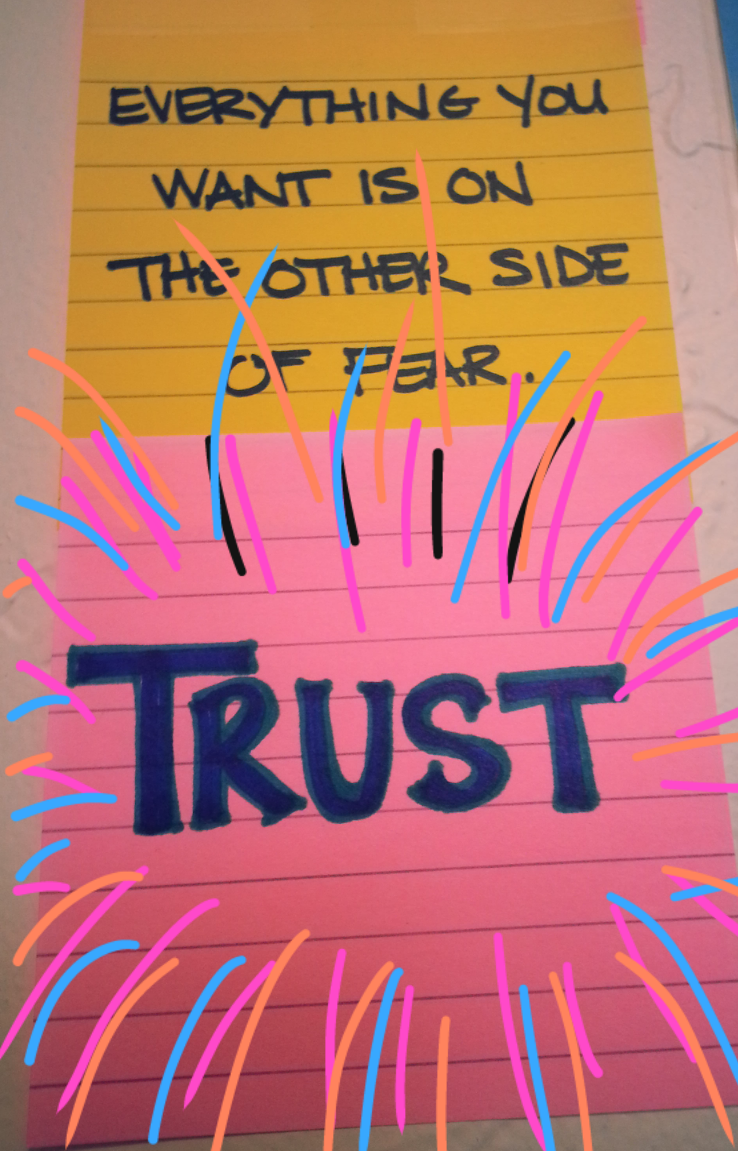
The opposite of fear is trust


I recently came across a quote that really stuck with me: "Everything you want is on the other side of fear." (As is typical with quotes found on the web, this one is attributed to several different people, either Jack Canfield, Gered Mankowitz or George Addair. Take your pick.)

As I ruminated on this, I realized that much of what happens in my business is governed by fear. Either I'm too scared to create a new program because it might fail, or I try something new but don't fully commit because I'm afraid it might fail. At least if I'm not fully committed, I can't be too hurt when it falls apart, right?

I'm learning not to get too attached to outcomes and to jump in and try new things even if I'm scared. I'm learning that probably most of what I try won't work, but the things that do will REALLY work. And it's okay to fail, tweak, try again, quit, tweak, try again, and so on. And even to finally give up on a project if it's just not right.

And I have to accept the fear of the unknown and the fear of failure and push through it anyway, taking risks and testing the results (something I tell you a lot on this blog when talking about things like the comfort zone).

And this leads me to my theme word for 2014: "Trust."

If everything I want is on the other side of fear, then what's the opposite of fear? What can I focus on this year that is NOT fear (because who wants to focus on that?), but just being okay with some fear and doing stuff anyway?

It occurred to me that trust is the opposite of fear. If I just trust that things will work out the way they're supposed to, that will reduce a lot of my fear.

That doesn't mean I don't still work hard to make my programs and services the most awesome they can be. That doesn't mean I don't keep tweaking when something doesn't work. That doesn't mean I just hope and wish that everything goes the way I want.

But along with the hard work and the audience research and the constant learning, I just have to start trusting that I'm on the right track. That if I keep learning and adjusting and growing, a lot of what I do will be the right thing and a lot of what I put out to the world will be successful. Not all of it. And that's okay. Taking risks is what being an entrepreneur is all about and I knew what I was getting into when I started this business!

Can you do that this year? When you think about all your fears and anxieties about speaking, can you trust that as long as you put effort into caring about your audience, learning and growing and improving, that you will have success?

Please share in the comments: Do you have a theme word this year?

____________________________________________________
On The Everything Page you'll find everything you need to build visibility, credibility and influence through engaging presentations that move your participants into action: freebies, low-cost products and courses, and 1:1 coaching!

Related Posts Plugin for WordPress, Blogger...