Showing posts with label Athletes. Show all posts

Does Tom Brady even eat bread?


Have you seen the new Subway commercial featuring Tampa Bay Buccaneers quarterback Tom Brady?

The dialogue goes like this:

Brady: This new turkey Cali Fresh is incredible
Stephen Curry: You even eat bread?
Brady: Steph, it's a commercial.

I don't follow Tom Brady, so I wasn't aware of his dietary choices and lifestyle. But Curry's question, "You even eat bread?" made me look it up.

Turns out Tom Brady has his own diet plan called the TB12 Method, that came out in a book in 2017.

Summarized on the Healthline website, "The Tom Brady Diet encourages eating minimally processed, whole foods and restricting processed ones. It recommends avoiding foods deemed inflammatory or acidifying and includes a few additional rules."

One of the rules is avoiding gluten.🍞🥖🥪

Hence Steph Curry's question.

Whether or not you find this endorsement hypocritical, there's something you can take away from this commercial to improve your presentations.

👉🏼Always anticipate objections.👈🏼

When you give a presentation, there will likely ALWAYS be someone in your audience who is critical of your message, who doesn't believe you, who has some concern about your topic.

Most of the time, the people who object to your message or ideas won't speak up. This means they're stewing, resistant, or at least distracted by their own objections... and they're not fully engaged with you.

Sometimes they will speak up, and you can plan in advance to have answers to their questions.

Or, you can build the objection into your presentation, by saying something like "I know some of you are probably thinking 'this won't work' or 'I've already tried it,' and let me address that."

When you KNOW there are objections, don't wait for the audience to bring them up. Build them into your presentation; acknowledge the audience's concerns and show them you've done your homework.

Brady's response to Curry's question about eating bread, "it's a commercial," doesn't really answer the question "Why is Brady endorsing something he doesn't eat?" He might as well have said, "I got paid." I'm going to go out on a limb and say his critics were not satisfied by that answer.

But the point I want to make here is that Subway built in the objection by having Steph Curry ask the question. It's the question on the minds of everyone who sees the commercial and knows about Brady's restrictive eating habits.

At least in a presentation, you have time with your audience to address objections. This commercial clearly doesn't say enough, and Brady is being called out all over for this endorsement.

Just remember: There will always be someone who objects to your message, your ideas and your methods, so don't be caught off guard.

At minimum, be prepared to address objections from audience questions, and ideally, 🛠build🛠 objections into your presentation so your audience knows you get them.


____________________________________________________
On The Everything Page you'll find everything you need to build visibility, credibility and influence through engaging presentations that move your participants into action: freebies, low-cost products and courses, and 1:1 coaching!

Do you need massive action or fine-tuning?


One of my clients just emailed out his speaking schedule, inviting colleagues to attend. I was mistakenly added to the group—wrong Lisa!

Here's what I saw:

29 speaking engagements... over 3 months... across five midwestern states (they drive to the majority of their engagements).

And they do this every year. The owner of the company, the president, and several of their team members fan out across the midwest to speak to current and potential clients about their company and offerings, and to discuss agricultural issues, trends, and data.

I first worked with the owner of the company in 2013. In 2015, he hired me to train 15 of his employees. After the group training, I worked with several team members in a small group coaching cohort.

In 2016 and 2017, I worked with the president and another individual on their presentations, and this year, I provided additional coaching sessions for the president and another speaker.

Why are these clients still coming back to work with me, six years later? No, it's not because I'm an amazing coach. (Okay, I am an amazing coach!)

I mean, each one of these guys does somewhere between 20 and 25 presentations a year. Do they still really need to work on what is essentially the same presentation every year with updated data?

They're still working with me because they know there's always room for improvement! These men are stellar presenters. And their business grows every year, with new offices and new staff, because of it.

Every time we meet, we're making small tweaks, changing up the presentation openings, adding new interactive activities, finding new stories, and digging deeper into engagement techniques.

We're tightening up the core message, which may change from year to year, depending on what trends and issues arise.

And we're laser-focused on converting prospects to clients and current clients to renewing clients. This is still a requirement, every year, to grow their business. They always need new clients and they always need current clients to renew. As do all of us who are business owners.

Each time we meet, the president comes to the call with a series of questions to be answered and problems to be solved. And we tackle each one systematically until we have a solution.

Then he tests out our work in front of an audience and analyzes the results. And then, as they say, we "rinse and repeat."

High-level business speakers who have a lot of experience and years of presenting under their belt may feel that they no longer need support for their speaking. Or they may only seek out support when there's a high-stakes presentation looming on the calendar.

But as I've mentioned many times on this blog (because speakers and athletes have so many similarities), even the highest level athletes still have coaches.

Why? Because most of us are too close to our own work to identify what needs to change or how to change it.

And because those subtle calibrations that an elite athlete makes to their training and practice, with their coaches’ help, can create a huge advantage on the field, track or court between them and their competitors.

Florence Griffith Joyner still holds the women's 100-meter world record from 1988 at 10.49 seconds. Carmelita Jeter is right behind her at 10.64 seconds, a time recorded in 2009. The two closest times recorded in this decade were in 2012 and 2016 by Shelly-Ann Fraser-Pryce and Elaine Thompson. But still Flo-Jo (who died in 1998) holds the record.

Luckily, there's no competition to measure micro improvements to your presentations! Fine-tuning works as long as you're achieving your own desired results.

Business leaders who speak to grow their businesses also need to create an advantage over their competitors. In the coaching world, we say there are no competitors because each of us brings our own "special sauce" to our work, and each of our businesses is completely unique and different.

But unless you make yourself stand out from the others in your industry, unless your prospects and potential partners know how unique and different you are, your business may still appear to blend into a sea of similar companies.

There is no advantage to blending in. There is no advantage to appearing the same as others in your industry.

What are you doing to tweak your message, to fine-tune your presentations, to make yourself stand out when you speak in the community, at industry events, or even within your own company?

You don't need massive action anymore. You are at a level where the details are what matter. The fine points of your message, the minutiae of your slides, the arrangement of your paragraphs, the choice of one word over another.

This is the level where your adjustments may be small but will have major impact.

How are you creating incremental improvements in your presentation? And how can I help?

____________________________________________________
On The Everything Page you'll find everything you need to build visibility, credibility and influence through engaging presentations that move your participants into action: freebies, low-cost products and courses, and 1:1 coaching!

I can do anything better than I can


Maybe you've heard the song "Anything You Can Do" from the musical "Annie Get Your Gun." It's a classic duet with the characters Annie Oakley and Frank Butler attempting to prove their ability to outdo each other in a variety of tasks. 

Some people are more competitive than others; I'm not a fan of my competitive side (I take competition a little too seriously, so I choose not to compete with others), but I do enjoy competing with myself!

As a speaker, it can be really easy to fall into the trap of comparing ourselves to and mentally competing with others. While it's often helpful and motivating to find inspiration in the veterans who have achieved the goals we're still striving for, it can also be demotivating to perceive our own levels of success to be disappointing in comparison.

I wrote this in another post, and will share it here as a reminder:

"Where were you a month ago or a year ago in your development? Look how far you’ve come! Look at what you’ve accomplished over time. When you compare yourself to yourself, you’re much more likely to come out ahead. And if not, at least you know intimately where you’re letting yourself down in your own growth and improvement....

When you understand the value and unique perspective you bring to your audiences and clients, there is no longer any need or desire to be like or to copy someone else."

Instead of "Anything you can do, I can do better," how about trying this reframe, from Visa's Olympic-inspired commercial? Athletes compete against others, but also fully embrace the challenges of competing against their own best performances.

(Lyrics below the video.)


If you'd like some help with the mindset part of your speaking toolkit, in addition to pumping up your speaking skills and strategies, you can still sign up for my Shake Up Your Speaking retreat, coming up March 19-21. Don't wait too long, though; there are only four spots left!

Lyrics:

Anything I can do, I can do better
I can do anything better than me
Yes I can. Yes I can. Yes I can. Yes I can.

Anything we can be, we can be greater
We can be anything greater than we
Yes we can. Yes we can. Yes we can.

I can do more than I ever imagined
I can do more than I ever dreamed
Yes I can. Yes I can. Yes I can.
Sooner, not later I'm greater than me

____________________________________________________
On The Everything Page you'll find everything you need to build visibility, credibility and influence through engaging presentations that move your participants into action: freebies, low-cost products and courses, and 1:1 coaching!

Lessons from the Olympics: Turning a mistake into a win


If you watched the opening ceremony of the Winter Olympics, you noticed that there was a snafu with the display of the Olympic rings, when an electronic snowflake that was supposed to expand into the fifth ring never opened.

I've written in the past about elite and Olympic athletes who don't dwell on mistakes, but get up from a fall or crash and keep performing, sometimes going on to achieve even more than expected. Well, clearly, Olympic ceremony designer Konstantin Ernst has the same die-hard spirit.

In the closing ceremony, the rings were formed by a group of dancers wearing glittering costumes. As the rings formed, one group of performers instead stayed in a small, tight circle (to represent the opening night snowflake) for a few hilarious moments, parodying the opening night mishap. But unlike the opening ceremony, the fifth ring finally expanded and joined the rest.

Watch here: https://youtube.com/shorts/Py_hcezSLAA?si=97HWtyRX96F3pffU

By incorporating his mistake and poking fun at what initially was probably somewhat embarrassing, Ernst shows his sense of humor, his flexibility, his willingness to laugh at himself, and his ability to take a mistake and make something even better out of it.

We're all going to make mistakes on stage. For most of us, millions of people around the world won't be watching. But for our audiences who are, demonstrating grace and resilience under pressure, a sense of humor, and the understanding that we're all human will go far to entertain and connect with the audience -- and perhaps give our presentation that extra luster that people will remember long after it's over.


____________________________________________________
On The Everything Page you'll find everything you need to build visibility, credibility and influence through engaging presentations that move your participants into action: freebies, low-cost products and courses, and 1:1 coaching!

In speaking, as in sports, the reward outweighs the risk


Photo: World Figure Skating
The Winter Olympics are full of risk-taking athletes. They jump, they spin, they twirl, they flip, they slide, they glide, and they push as hard as they can -- all at the risk of falling on their behinds and losing time, points and medals.

For a lot of the athletes, they know they might fall down, and even face serious injury, but that doesn't keep them from performing at the highest level.

For example, the announcers talked all week about  two-time World Champion figure skater Mao Asada, one of a handful of skaters who has landed a triple Axel in competition. Would she be able to accomplish this high-scoring feat during her short program?

Asada attempted but did not land her Axel in the ladies's short program. She was a favorite for the gold medal and the reigning silver medalist. She took the risk and didn't succeed, in fact, falling down to 16th place.

But the potential reward was worth it for her. She still performed her long program like a champion and -- guess what -- she landed the triple Axel and a plethora of other triples and combinations. Unfortunately, she was out of the running for a medal, finishing in sixth place. In the end, her score was a personal record.

Was she disappointed not to win a medal? Of course. Do you think she regrets taking the risk? Not for a minute. She said to a reporter, "With this performance, I could thank all the people who supported me all this time."

There are snowboarders and skiers who try extremely risky tricks, some of which they've only completed in practice and never in competition. But the potential reward outweighs the risk, which is why they do it. The chance of representing your country with a gold medal is a huge motivation, not to mention delivering personal best performances and justifying years of hard work.

How does the reward of speaking outweigh the risk for you? 

We all experience some risk when we get in front of an audience. We know there's a chance we might come across as less than stellar, that the performance we imagine in our heads might be a whole different thing in reality. We know we might forget our words, have a technology breakdown, or demonstrate our nervousness with shaking hands or quivering voice.

But are these risks really so huge when you think about the rewards?

As I mentioned in this post, some of the rewards of speaking include:
  • The opportunity to share your message with a captive audience
  • Learning about yourself as a person, and facing your personal challenges
  • Connecting with people and building relationships
  • Helping people move forward and take action
  • Expressing your ideas, changing minds and facilitating personal transformation
  • Not to mention building your visibility, credibility and reputation, which leads to promotions, clients, customers, more important leadership roles, and personal and professional growth.
You're not in danger when you speak. You're not going to get a concussion or tear your ACL. You're not going to be fired or shunned from society. The rewards far outweigh the risks. So what are you waiting for?

____________________________________________________
On The Everything Page you'll find everything you need to build visibility, credibility and influence through engaging presentations that move your participants into action: freebies, low-cost products and courses, and 1:1 coaching!

Connecting without words: Lessons from Jason Brown's performance


It's that time again, when the ramp-up to the Olympics is ... rampant. There are national championships galore, in just about every winter sport, and you can start getting your Olympics fix right now, weeks before the games begin.

I'm a figure skating fan, but I missed the U.S. Nationals, which is why I was intrigued when I started seeing Jason Brown's name all over social media. He's a young skater, just a year out of the junior ranks, but he must have done something pretty amazing to warrant so much attention. So I watched.

The announcer gives a little hint right up front at what makes Jason Brown so notable: his ability to connect with the audience. When you watch this performance, I think you'll agree that he's a master of connection. And yes, all while skating, doing impossible jumps, footwork and spins -- and while not speaking a word.


If you can't see the player, click this link to watch on YouTube.

Watch how he times his jumps and gestures for when he's directly in front of the audience. Watch how he makes direct eye contact, even as he's whizzing by them at high speed. Watch the smiles and facial expressions that demonstrate his enjoyment and the fun he's having on the ice. Watch the audience rise to their feet in a standing ovation before the routine is even over. They just couldn't control themselves!

There are figure skaters who clearly take themselves too seriously. They never smile. They never connect with the audience. They seem to be in their own little world, focusing on not making mistakes and on technical elements. And there are speakers who do the same thing.

In this sport, however, competitors are judged not just on their technical proficiency, but also on performance, interpretation and other artistic elements. As are speakers when they stand up in front of an audience. Performance is necessary. Entertainment value is critical. To those of you who think speakers must be serious and somber and pompous and grim in order to be taken seriously, you are missing a huge emotional component. Your score will suffer.

Which is why young Jason Brown, with only a year of senior competition under his belt, came in second to veteran skater Jeremy Abbott and was chosen as only one of two American men to skate at the Sochi Winter Olympics.

How are you finding ways to connect with your audiences... without words?

____________________________________________________
On The Everything Page you'll find everything you need to build visibility, credibility and influence through engaging presentations that move your participants into action: freebies, low-cost products and courses, and 1:1 coaching!

Are you a flabby speaker?


You know how annoying it is when that friend of yours who never works out and never eats healthy food decides to get in shape... and instantly loses ten pounds? While you continue to struggle to lose the same ten pounds you've been fighting to lose for months?

When you're already fit and healthy, it's harder to make big, dramatic strides. You're already eating right. You have to work harder to tweak your diet. Your exercises have less of an impact now; you need to "shock" your body to make bigger strides in your fitness level.

It's the same way with speaking.

The more experienced you are as a speaker, the deeper and more refined your training becomes.

You're not starting from scratch, learning the basics of engaging the audience, moving your body effectively, making eye contact, telling stories, and all those things that are complicated and scary for beginners. When a beginner starts from nothing, he or she is going to make great strides in their progress. They're starting from zero and every breakthrough is a big step.

Not so with us veterans.

We don't make huge breakthroughs most of the time, so we have to focus on the subtle tweaks and adjustments that allow us to continue growing, continue mastering the art and science of speaking, continue creating more effective presentations, and continue building our connection and relationship with our audiences.

Don't think that your growth and progress are "over" because you've been doing this a long time. Look at your progress as small refinements with big impact.

When's the last time you introduced a new exercise or activity into one of your presentations?

When's the last time you thought up some new questions to ask your audience?

When's the last time you challenged yourself to try something scary, like singing or acting out a character or something that's new and different for you?

When's the last time you added some content that rocks the boat or might be considered controversial in your field?

If you're not doing these things, you're stagnating. And, like the fit person who gets lazy about exercise and diet because he's "already there," you lose your edge, you lose your fitness, you lose your muscle tone, you lose your conditioning.

Dig deeper to find that next level of mastery. Add new tricks to your bag. Complacency will make you weak and flabby as a speaker, just like it does to someone who's in shape and thinks they don't have any more work to do.

Get creative and stay fit!

____________________________________________________
On The Everything Page you'll find everything you need to build visibility, credibility and influence through engaging presentations that move your participants into action: freebies, low-cost products and courses, and 1:1 coaching!

Is your mental game up to par?


I recently watched a documentary about a group of cyclists who race 2,700+ miles from the Canadian border to the Mexican border along the Continental Divide. The race is called the Tour Divide, an "ultra-cycling challenge to pedal solo and self-supported the length of Great Divide Mountain Bike Route...as fast as possible."

Only a few people attempt it and fewer finish (in 2008, the year this documentary was filmed, 16 started and 8 finished). One competitor who had a particularly hard time was Mary Metcalf-Collier, who suffered physical hardships along the way, including severe swelling in her legs.

She came close to quitting many times, but she knew the key to staying in the race was her "mental game," and she continued to push herself past her discomfort, eventually becoming the first woman to complete the race.

She says in her blog, "The most important lesson that I picked up last year was about flexibility. As I read back through my journals from 2008, I probably had 3 days total that went exactly as planned."

Most of us aren't facing this level of physical pain when preparing for a presentation. But many speakers' mental game is not up to the challenge of overcoming anxiety and the resulting resistance and avoidance.

The mental game of speaking includes:

1. Planning and preparation for things that might go wrong

What happens if your computer crashes in the middle of your PowerPoint? What happens if you lose your place? What happens if someone gives you a hard time during Q&A? Are you prepared?

2. Reframing anxiety and nervousness into positive attitude and energy

There is no difference between "bad" and "good" adrenaline - it's your mind that makes it so. Thought stopping, positive self-talk, relaxation and other mental and physical tools can get you in a calmer state to face your audience.

3. Visualizing a successful presentation

Have you visited the venue in advance so you know the layout of the room and any challenges? Have you envisioned yourself in front of a satisfied and smiling audience, giving waves of applause? Successful elite athletes use visualization and mental rehearsal both to imagine a successful outcome of an event and to rest and relax.

4. Giving 100% when you only feel 50%

Got the flu, but can't find a replacement? Performing on two hours of sleep? Distracted by personal problems? Your audience can't and shouldn't know this. Give them what they came for and rest later.

5. Handling mishaps onstage in the moment with grace and humor

Everyone makes mistakes and most of the time your audience doesn't even know you've messed up. Suck it up, laugh it off, and move on!

6. Being flexible

Sometimes you're prepared to speak for an hour, but the speaker or meeting before you goes long and your time gets cut. Sometimes you expect an audience of fifty and it ends up being an audience of five. Sometimes you get stuck with a microphone that's attached to a lectern. Having a strong mental game means being able to shift gears at a moment's notice, take what you're given, and run with it.

As you can see, the mental game of speaking parallels the mental game of sports, and speakers can learn a lot from athletes who use these tools. Read more posts about the connection between athletes and speakers here.

What else would you add to my list? Please share in the comments!


____________________________________________________
On The Everything Page you'll find everything you need to build visibility, credibility and influence through engaging presentations that move your participants into action: freebies, low-cost products and courses, and 1:1 coaching!

What if you could share your message only once every four years?


Do you take your speaking opportunities for granted?

Do you rehash the same presentation over and over without refreshing the stories or finding new and better ways to express your concepts? Do you give the same canned talk to every group without bothering to find out who's in the audience? Do you feel burdened and put-upon every time you speak instead of feeling gratitude for the opportunity to educate, inform, persuade or entertain this group of people who have give their time to hear you?

Now consider this: What if you could share your message only once every four years? But when you spoke, you had a worldwide stage?

How would you present differently?

* Would you make an extra effort to be clear and concise, so there was no confusion about what you were saying?

* Would you test your equipment first to make sure you knew how to use your presentation remote and your microphone?

* Would you go to great lengths to provide relevant and valuable content to your audience, because you might not get another chance to be in front of them?

* Would you commit to thorough preparation and practice so you could be almost 100% sure of knowing your stuff, delivering it well and not wasting the audience's time?

* Would you pay more attention to your visuals, your props, and your methods of involving and interacting with the audience in order to keep them engaged the entire time?

Once every four years, we're able to watch the world's elite athletes compete at the highest level of their ability. They train year-round to peak at exactly the right time for their most prestigious competition.

The difference between Olympic athletes and (many) speakers, however, is that elite athletes push themselves to do better ALL the time. Not just when the Olympics roll around. Whether they have a worldwide audience or they're competing at a non-televised event like the Mt. Sac Relays, they always bring their A game.

They might hold back a little in the preliminary rounds to save energy for the finals, but they are still competing at a level far above the average athlete, and their process is well thought out and carefully planned.

Speakers, however, frequently do the bare minimum to get through an engagement. They put their presentations together at the last minute; they pay no attention to who's in the audience, and they focus only on their own comfort and convenience by reading from bullet-laden slides and drowning the audience in data.

Only when an "important" presentation comes their way (based on the size of the audience or the impressiveness of the people attending) do they suddenly awake from their comatose state and leap into action.

Unfortunately, because there is no regular habit of proper preparation or commitment to excellence, this speaker is at a loss. He can't even begin to figure out how to create or deliver an effective presentation because he has built up no "muscle memory" over time of the speaker habits that are necessary to make this happen.

Every time you speak is an opportunity to improve, to strengthen your skills, to build your speaking and confidence muscles. Every time you speak is an opportunity to put your best out there. Every time you speak is an opportunity to make an impact, give value and be memorable.

It's all up to you.

If you feel that your presentations aren't where you want them to be because you don't know where to begin with your own process for creating audience engagement, I'll be offering my new teleseminar series, "Speak to Engage: 7-Step Shortcut to Public Speaking Success," this fall. Get on my advance notice list (which will still be open for a short time) to get updates, early bird specials and other goodies as we get closer to launching the program.

____________________________________________________
On The Everything Page you'll find everything you need to build visibility, credibility and influence through engaging presentations that move your participants into action: freebies, low-cost products and courses, and 1:1 coaching!

Feeling the pressure or feeling the excitement?


"You ask her about feeling the pressure and she says 'I don't really feel it." And you know, I think it's because she labels it something different in her head. Some kids feel anxiety, feel pressure. She feels excitement. It's just how you label that."

~ Tim Daggett, Olympic gymnastics commentator, referring to gymnast Aly Raisman

How do you label your public speaking nervousness? Do you say, "I hate public speaking?" Do you tell yourself you shouldn't be anxious and then feel disappointed when you can't make the jitters go away?

How about taking that adrenaline rush and turning it around?

How about saying to yourself, "I'm excited to have the opportunity to share my message with this audience?"

How about finding ways to relax your body and ground yourself so that your jitters become more manageable?

And then, how about using that remaining adrenaline to give the audience the best, most energetic and passionate, version of YOU?

____________________________________________________
On The Everything Page you'll find everything you need to build visibility, credibility and influence through engaging presentations that move your participants into action: freebies, low-cost products and courses, and 1:1 coaching!

"I'm a race car driver!"


Yesterday I had the pleasure of hearing Tanis Hammond, a member of one of my networking groups, tell her story of land speed racing on the Bonneville Salt Flats. Tanis is currently the fastest woman at Bonneville, having just set a new record last August at 323 miles per hour. She was also the first woman to join the "300 club."

Her story struck me on many levels, but the clear message of her talk was "Say yes."

Tanis talked about having the opportunity to drive a race car back in the 80s, as her husband was already involved in the sport. She says, "I don't know what my life would have been if I hadn't said yes."

When she got into the car in 1987 to take her first run, she said to herself, "What am I doing here? I have three little kids!" But the fear quickly dissipated. She pointed out to us that land speed racing is a dangerous sport, but if you focus only on that aspect of it, you hold yourself back from all the great experiences that come with racing.

There were two aspects of Tanis' talk that were particularly interesting to me. One was the idea that we're all afraid and we're all courageous. Tanis may not be afraid to drive a car over 300 mph, but she is afraid of public speaking, which she told us right up front. I loved her final quote:

"I was so afraid to get up here, but I'm going to go through the rest of the day on cloud nine because I did it."

Now, she may not be screaming with joy the way she was when she first broke 300 mph, but she was certainly experiencing some of that good adrenaline we get when we stand on a stage and share our passion with an audience!

Tanis has internalized the concept of "Say yes." She may not love speaking; in fact, it might make her extremely anxious, but she doesn't say no. She challenges herself to get up there and tell her story. She knows she has something to say and she's willing to deal with some discomfort in order to spread her message.

The other aspect of Tanis' talk that resonated with me was the issue of self esteem and the "impostor syndrome."

Tanis has been racing since the 80s and has set many land speed records. She is one of only 11 women and 665 men competing in the sport. Yet, it was only when she set the record at 323 mph that she came out of the car saying, "I'm a race car driver!"

All those years, all those records and awards, and yet Tanis wasn't quite ready to embrace it. She told us, "A sense of self esteem comes from actions and accomplishments," but she had been unable to accept her own accomplishments.

How often do you put yourself down or deny your [public speaking] accomplishments because you're still waiting for the "big thing" to come along? How many of you disregard your [public speaking] skills and talents because they don't measure up to someone else's unattainable achievements?

This is the second message I got from this presentation: "Embrace your success." Look at what you've done in your life and your work and own it -- NOW. Celebrate it -- NOW. Sure, you'll achieve more, but don't forget to take credit for what you're doing NOW.

One technical comment about Tanis' presentation and her use of stories. She's talking about something that none of us in the room have done, and that none of us will likely ever do. How do you talk about racing a car at 300+ mph and ensure your audience feels connected?

Tanis did a great job of telling us all the technical stuff about the car (the small parachute on a spring that pops out and deploys the bigger parachute), the salt flats (reflection so intense you get sunburned under your arms), the mechanics of racing (her hands strapped to the steering wheel), the relationships (the women of racing "have brought a softer side to Bonneville"), how it feels (we saw it for ourselves on video)... and never once did I feel lost or confused. She made her topic easy for anyone to understand, and this is a storyteller's gift.

I particularly loved the analogy she used to describe how fast one is really going at the 3- or 4-mile mark in a race.

She gave us a framework for understanding the distance and speed by referring to a local offramp we all know and a pedestrian footbridge about two miles down the road from that. Then she told us to imagine counting 12 seconds from the first offramp... she'd already be at the footbridge.

I tested this out later; I admit it, I set the countdown timer on my phone for 12 seconds and started the trip meter in my car at the aforementioned Las Positas offramp to see how far I got in 12 seconds. It was really cool to see for myself what she had been describing.

This was an example of how you can be nervous and you can be inexperienced, but if you have a clear message, good stories, good visuals and lots of passion, your audience will never be disappointed.

I want to leave you with this awesome video of Tanis' son Channing going 293 mph on the salt flats. The video is from the perspective of the driver, and I really grasped the concept of high speed while watching this. After all, as Tanis mentioned, there are no other cars or buildings to pass on the flats to judge your speed by, so you don't even necessarily feel it!


293 MPH RUN World Finals from Channing Hammond on Vimeo.

Video description: The strings taped to the car are for a study of the air passing over the body. The car is pushed off the starting line by a push vehicle up to 45-50mph and then the run begins.

At the end of the run behind the camera the parachute is deployed and from the sound you can hear the car decelerate. The car is going about 100mph when I pull off the track and make my way to the return road, where I am met by our "elated" crew with the trailer to tow the car back to the starting line for another run where we qualified for the record with a 318mph 5th mile time with a 323mph terminal exit speed.


____________________________________________________
On The Everything Page you'll find everything you need to build visibility, credibility and influence through engaging presentations that move your participants into action: freebies, low-cost products and courses, and 1:1 coaching!

Can't sleep before a presentation? Here's a tip from a Super Bowl MVP


Ellen Degeneres interviewed Aaron Rodgers, Green Bay Packers quarterback and Super Bowl XLV MVP shortly after the Super Bowl...

Ellen: It's your first time going to the Super Bowl. Even though you know you're good, you've gotta be scared. Kind of?

Aaron: Not really, no.

Ellen: The night before? You can sleep?

Aaron: I had my best night of sleep the night before the Super Bowl.

Ellen: How is that possible?

Aaron: It was such a long process. I studied for two weeks on our opponent. So by the time I got to Saturday night, I was so tired of watching Pittsburgh film, I felt so good about our game plan, that there was nothing to worry about.

Usually, laying in bed, you might have some doubts about "How's this gonna go?" I'd already played everything out in my mind and visualized it, and studied the game plan and studied the Steelers, that I just had a great night of sleep.

Interestingly, Drew Brees, quarterback for the New Orleans Saints said almost the same thing when interviewed by Ellen:

Ellen: Two minutes to go, and you were one score away from tying it... What goes through your mind? How can you be calm enough? You're watching the clock...

Drew: As I prepare throughout the week, I imagine that situation probably 10, 20 times. So that when you get to the actual moment, two minutes left... where you don't want to have to think, you just want to be able to react. And since you've already played it over in your mind a bunch of times and you've seen the result being success, you just operate, you just do it, you just execute.

What's your game plan before a presentation? Do you study? Do you plan? Do you visualize? Do you have preparation rituals to get ready mentally and physically?

____________________________________________________
On The Everything Page you'll find everything you need to build visibility, credibility and influence through engaging presentations that move your participants into action: freebies, low-cost products and courses, and 1:1 coaching!

How are your observational skills?


During last night's Tour de France coverage, commentator Craig Hummer made the following segue:

"We should make note of the area's most famous landmark, the coal mine behind us. A lot of riders, Bob, are going to have to dig deep today."

Clever! He managed to give a bit of information about the area, and use the expression "dig deep" as a subtle double entendre, in order to transition to his next idea.

Observational humor is a well-known public speaking tool, where the speaker takes something that has happened or is happening in the room and spontaneously brings it into his presentation for a laugh. Here's an example from John Kinde's Humor Power blog:

"At a company awards luncheon it seemed as though nearly everyone receiving 5, 10 and 15-year service awards had started in the company's telemarketing department and had subsequently worked their way into other jobs. I added a new line to my opening monologue. 'People call me a comedy magician because they laugh at my magic and they're mystified by my jokes. But I wasn't always a comedy magician. I used to work in telemarketing!' It was on target and received a great response. The audience appreciated the fresh, spontaneous nature of the remark."

But what about using observation in a non-humorous way? (Is there a name for this? Observational talking?)

This is simply where you refer to people, events and surroundings throughout your presentation to use as examples and to illustrate your points. You don't necessarily have to be as clever as Craig Hummer, but think about how you can bring back something someone said or did as a way to make a point.

You might find it difficult to use your observational and listening skills during a presentation while you're talking and thinking and trying to stay focused on your topic. However, you will improve the more you try it, and the more you focus on the audience instead of yourself and your need to be liked or your various discomforts.

I recently gave a training to an organization that was using the meeting room at our local zoo. They had about a half-day of training planned, after which they were going to take a train ride around the zoo and visit some of the behind-the-scenes animal living areas.

In my opening to the presentation, I asked two of my typical questions, one about how many people love or dread speaking, and the second about how they rank their skills as a speaker. My third question was "How many people in the room have fed a giraffe?"

This brought a little humor and shook things up a bit with the observation that, not only were we at the zoo, but that the group would very shortly be hanging out in the giraffe's "bedroom." I did have to mention that I was a Zoo Camp counselor 20 years ago and that part of my training in deflecting embarrassment was walking around the zoo day after day, singing songs at the top of my lungs, trailed by a group of six-year-olds (aka The Squirrel Monkeys).

Members of my referrals networking group have become masters of observation. At one meeting, Ellen, whose products include vitamins and healthy cleaning products said, as part of her 30-second "commercial": "We need this kind of excitement every month...so don't get the flu!" At another meeting, Linda talked about looking at people's rings to determine if they might need a wedding photographer -- a segue from our resident jeweler, Calla's commercial.

Listen to your audience. Watch what they do. Notice how they joke amongst themselves. Notice what's happening in the room, outside the room, around your space. The more you focus on the group and the setting, the more you can use observation for both humor and illustration purposes. Your audience likes to know that you're paying attention to them, so there's an added bonus of bonding and connecting with the group through showing that you're in the moment with them.

How have you used your observational skills to liven up your presentations?

____________________________________________________
On The Everything Page you'll find everything you need to build visibility, credibility and influence through engaging presentations that move your participants into action: freebies, low-cost products and courses, and 1:1 coaching!

Play the hard teams


There's a team in our county that got beaten badly by our local team. After that loss, they decided they weren't going to play our team again.

Both as a former team-sport athlete and as a sports fan, I find it shocking that they are giving up the opportunity to improve their skills by playing a tougher team. The truth is, they've lost all their games this season, so I can see how they might feel demoralized.

But unless they want to give up and shut down their team, they are going to keep playing and they are going to keep losing. At least sometimes, because that's how it is for most of us!

When I first started out as a speaker, my audience was teenagers. And I was terrified. I was intimidated. I couldn't imagine making any kind of an impact, or even connecting with them at all. I don't even remember my first experience talking to a classroom full of teenagers; I must have blocked it out.

However, I kept going. (Well, I had to. It was my job.) I kept showing up. I kept tweaking my presentation to make it better. I learned from these high school students how to meet them where they were, how to engage them, how to understand their needs as an audience. I did it for six years. And in the interest of not repeating myself too much, I will direct you to the post I wrote about why you need real world experience, and what I learned from it.

Don't avoid the difficult audiences because you're afraid. Don't shy away from trying something new and hard because you fear embarrassment. If everything you do is easy, you will never grow as a speaker.

We all fail from time to time, but failure is nothing more than a learning experience. Keep learning, keep trying, keep fighting. You will succeed.

____________________________________________________
On The Everything Page you'll find everything you need to build visibility, credibility and influence through engaging presentations that move your participants into action: freebies, low-cost products and courses, and 1:1 coaching!

Fear makes you sharp


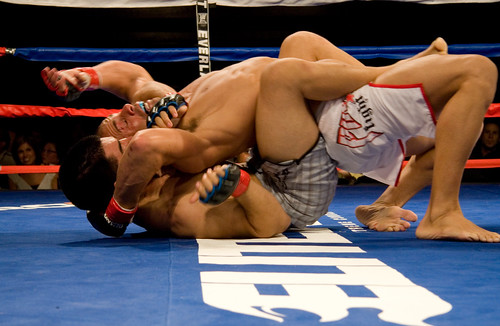
Before a mixed martial arts event the other night, fighter Matt Major was quoted saying, "I'm confident but insecure."

The commentator continued:

"A lot of guys, they try and kill their nerves, and go in there and go 'I'm not scared; I don't feel anything.' Well, a lot of times those nerves, that fear, will make you sharp. You'll see things before you would if you were calm."

So maybe you're not anticipating an audience member putting you in a rear naked choke, but your nerves, as demonstrated by professional and elite athletes over and over, are still a valuable tool on stage.

That extra adrenaline serves a purpose. It motivates you, makes you more alert, moves blood to your brain and muscles, makes your vision sharper. (It also shuts down digestion, leading to that dry mouth we all find so annoying.)

Try, instead of seeing nerves as something to be avoided, to reframe that adrenaline rush as something positive, something motivational -- a kick in the butt, if you will. Try using that adrenaline rush the way athletes use it. Adrenaline doesn't control an athlete; the athlete manages the adrenaline and the resulting physical sensations to push harder and do better.

So can you.

____________________________________________________
On The Everything Page you'll find everything you need to build visibility, credibility and influence through engaging presentations that move your participants into action: freebies, low-cost products and courses, and 1:1 coaching!

Crashes are part of the race


Download audio here.


Yesterday, I read this tweet from Lance Armstrong:

"Meanwhile, 6 of the 8 guys from our Flanders squad are down and out w/a stomach bug. #hopingimlucky"

Not long after that one came this tweet:

"Not so lucky I guess. Sicker than a dog now. This sucks."

The illness took him out of the four-day race he had just begun.

Having watched the Tour de France for the past eleven years as well as other cycling races, I have come to understand that riders will get sick, the weather will range from sweltering to freezing, people will crash, get injured and leave the race, and all of this is completely normal.

Sure, I imagine that the riders hope for perfect weather, no illnesses and no crashes, but that never happens. Because all of these things are part of the race.

I was having a conversation the other day with Susan Hyatt of Ideal Life Design, a client of mine, an accomplished speaker and life coach (I'll be posting our interview soon), and a similar topic came up, that of public speaking nerves.

Everyone gets nervous, some more than others. Some people are so petrified that they'll avoid public speaking at all costs. Some get a little stage fright right before beginning their presentations, and it goes away quickly.

Susan and I agreed on this: Nervousness is part of public speaking.

If you continue to wish and hope for this not to be the case, you will be disappointed time and time again.

A manageable amount of nervousness is actually beneficial to a speaker, as it creates energy and liveliness. It's a signal that you care about the audience and want to do well. It's a signal to your body that you're in a heightened state of awareness. In fact, you can actually reframe nervousness and train your brain to see it as excitement -- the same way you're excited and scared at the same time on a roller coaster.

But you can't expect that you'll never be nervous. It's a part of public speaking like crashes are part of the Tour de France. The best way to deal with nervousness is not to try to eradicate it, but to learn to manage it as a tool and use it to your advantage.

If you can move past the expectation of no nervousness, then you can focus on the important things: Your effectiveness as a speaker.

For more on managing your nervousness, here are some previous posts:

Cool as a cucumber or sweaty like a racehorse

This is why a little public speaking anxiety is a good thing


Baby steps to fighting fear


Feel the fear and speak anyway

Four steps to controlling your fear

Expectations

Tough Love Thursday: Drop the drama

Don't panic, plan it

____________________________________________________
On The Everything Page you'll find everything you need to build visibility, credibility and influence through engaging presentations that move your participants into action: freebies, low-cost products and courses, and 1:1 coaching!

Don't crash and burn


Another Tour de France analogy (sorry, folks -- if athlete analogies bug you, come back in a couple of weeks when the Tour is over!):

Some teams and riders have been caught off guard by tight curves and hairpin turns, causing crashes or loss of time taking unexpected turns too cautiously. The reason? Not all teams ride or drive the course in advance.

Here are two tweets by George Hincapie about preparing for race days:

"Rode the course two times this morning, then will another time this afternoon before race time. Course is very hard..."

"Heading to check ttt course again. Had a great night sleep..."

Here are two tweets from Levi Leipheimer:

"Rode the course this morning, had lunch, now I'm in my room getting ready 2 go 2 the bus/start & ride the course again, I start at 4:37 CET"

"Rode 4 laps of the TT today, getting to know it is important, deciding on gears to use isn't so easy"

Not only are George, Levi and their teams checking the course once, but they're reviewing it multiple times.

Riders will note how tight the turns are, how bumpy or gravelly the road is, where there might be slippery painted lines on a rainy day. They will note when and where to brake and shift, how steep the ascents and descents are, and where there are flat areas and shade to recover. And they'll look for spots on the course where there are headwinds, tailwinds, or crosswinds. These notes allow them to plan their team and individual tactics and timing, and to be as fully prepared as possible.

Why should you check your venue in advance? To find out:
  • Where the audience will sit and where you will stand

  • What equipment is available and where it is, if permanently placed

  • If the room can be heated or cooled appropriately

  • If there are street noises, sounds from other rooms, echoes from lack of floor and wall coverings, or noise from air conditioning or fans?

  • Whether the room is the right size for the number of people attending?

  • Whether your equipment works with the equipment being provided (computers, projectors, sound systems, etc.)?

  • Where tables can be placed to put your notes, props, water, products for sale, etc.?

  • What the lighting is like and where it's focused

  • If the doors slam or close quietly in case people come in late (you might need to tape the door latches flat)

And more!

Don't crash and burn because you didn't bother to check a new venue thoroughly.

____________________________________________________
On The Everything Page you'll find everything you need to build visibility, credibility and influence through engaging presentations that move your participants into action: freebies, low-cost products and courses, and 1:1 coaching!

A lesson from George Hincapie


Professional cyclist George Hincapie writes on Twitter (@ghincapie) today:

"Flatted with 25k to go, came back to group moved to front then crashed with 20k to go. Never been so scared on the bike as I was today."

At 36, Hincapie is a veteran rider of five Olympic Games, 13 Tours de France, dozens of international races, and has several national and world championships to his name.

Yet he still gets scared on the bike.

Sure, today's stage in the Tour de France was rainy and dangerous. Hincapie's injuries in past races include a separated shoulder, fractured wrist and broken ribs. He has good reason to be apprehensive.

But George keeps riding. He keeps getting on the bike and giving it all he's got. He hasn't risen to the position of team captain, won stages and races, and received awards like "Most Aggressive Rider" by letting his fears inhibit him and hold him back.

George faces disappointment regularly as a competitor; two days ago he wrote about being disappointed with his ride -- for about a minute.

No matter how hard, how frightening, how challenging the course, George keeps getting back on the bike.

So you're afraid of getting up in front of an audience. You're afraid of criticism and failure. You're afraid you won't do your best or meet your goals. And sometimes you won't. So what do you do?

How do you face your challenges and disappointments?

____________________________________________________
On The Everything Page you'll find everything you need to build visibility, credibility and influence through engaging presentations that move your participants into action: freebies, low-cost products and courses, and 1:1 coaching!

Practice like you mean it


While I was working out at the track the other day, football practice was in session on the field. I had the perfect vantage point to watch these young men run drill after drill, over and over, with constant adjustments from the coaches.

Here are some tips for you on practicing your presentation, based on the effort I witnessed on the field.

1. Practice right

What's the point of practicing if you're practicing the same mistakes over and over? Get some feedback, either through videotape, a trusted friend, or a coach, and work on practicing your presentations without ingraining your bad habits.

2. Practice as though you're in the game


These young men were running passing drills with the speed, focus and intensity you would see in a game. The quarterbacks blocked imaginary defenders (or sometimes the coach), ran their pattern and passed to the receivers, who on their side of the field were running their butts off to make it to the ball.

When you practice your presentation, practice as though you're in front of the audience. Try out your humor; speak with the emotion and passion you will demonstrate "in real life." When you practice it, it becomes natural and comfortable for you, and the audience can feel your enthusiasm.

3. Practice the details

The football drills were detailed and the players practiced specific patterns. The coach would stop them to point out body position, angles, footwork or passing techniques. Every detail and every second matters in sports, and in presenting.

Practice making eye contact. Practice using your props and flip charts. Practice using your remote device if using slides. Practice using your timer. If you'll be recording yourself, practice with the microphone and recorder so they won't distract you on the day. Pay attention to the details. Details count.

If these guys play like they practice, they've got nothing to worry about -- and neither will you!

____________________________________________________
On The Everything Page you'll find everything you need to build visibility, credibility and influence through engaging presentations that move your participants into action: freebies, low-cost products and courses, and 1:1 coaching!

What inspires you?


Today you'll find my guest post over at Chris Spagnuolo's Edgehopper blog. I decided to share a little about how I get my inspiration for blog posts and presentation ideas. If you ever experience mental blocks when creating, you might find my post helpful!

____________________________________________________
On The Everything Page you'll find everything you need to build visibility, credibility and influence through engaging presentations that move your participants into action: freebies, low-cost products and courses, and 1:1 coaching!

Related Posts Plugin for WordPress, Blogger...